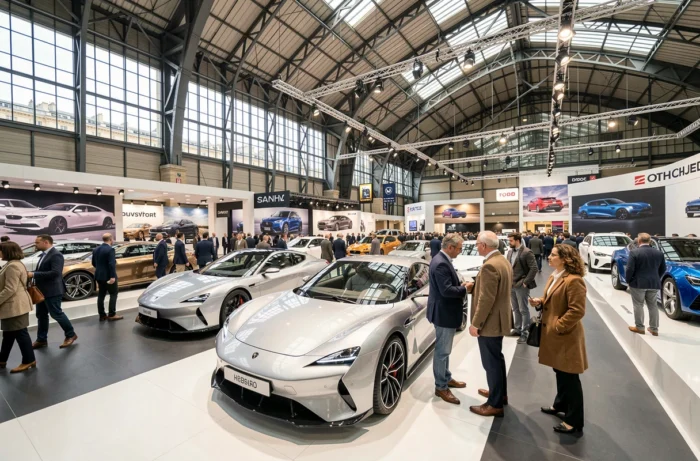
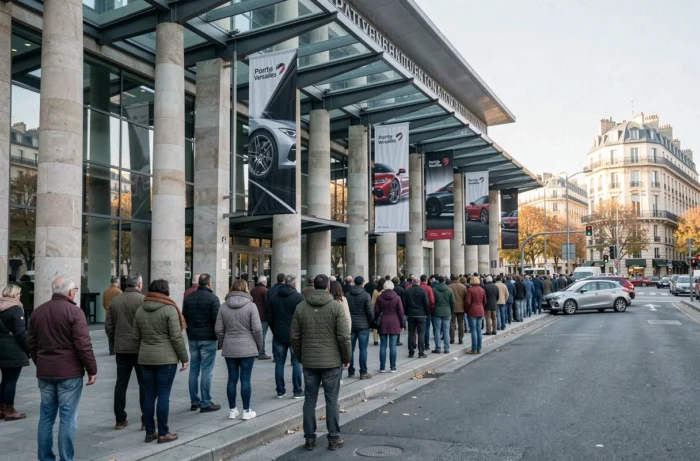
The 2026 Paris Motor Show takes place from October 12 to 18 at Paris Expo Porte de Versailles, for its 91st edition. Behind this familiar name, the event has changed in nature compared to the auto show as it existed in the 2010s. Reduced space, reorganization of exhibitors, integration of non-automotive players: the differences between the two formats deserve to be measured.
Exhibition space and hall configuration: what has changed since 2016
The most striking comparison between the old auto show and the current Mondial is in square meters. In 2016, the show occupied about 125,000 m² spread over 8 pavilions. The 2026 edition is limited to 70,000 m² and 5 interconnected halls, representing a reduction of over 40% of the total area.
This contraction is not just a logistical adjustment. The halls are now fully interconnected to create a continuous flow between indoor areas, outdoor spaces, and testing centers. The old format juxtaposed independent pavilions, each dedicated to a type of exhibitor. The 2026 Mondial organizes the visitor journey around themes (electric mobility, autonomous driving, industrial competitiveness) rather than by brand or country of origin.
To understand in detail what distinguishes the 2026 Paris Motor Show from its predecessors, one must also look at the strategy of the manufacturers themselves, who are now weighing the balance between physical presence and private events.
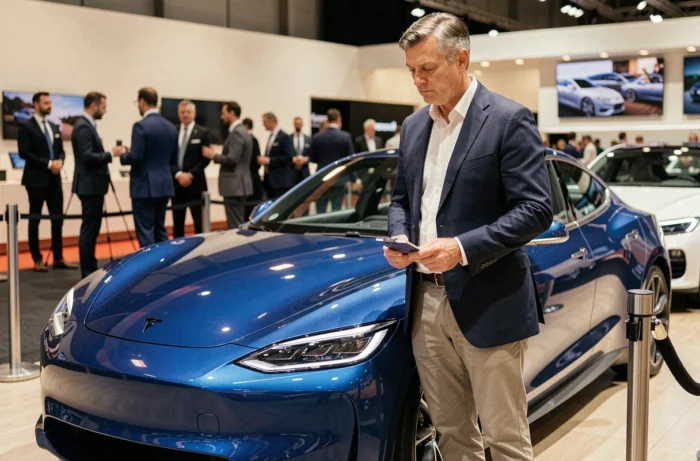
Classic auto show vs. Mondial 2026: comparative table
| Criterion | Auto Show (pre-2020 format) | Mondial de l’Auto 2026 |
|---|---|---|
| Total area | About 125,000 m² (8 pavilions) | 70,000 m² (5 interconnected halls) |
| Frequency | Biennial since 1976 | Biennial, maintained |
| Typical exhibitors | Manufacturers, equipment suppliers, accessory makers | Manufacturers, energy players, tech (AI, SDV), mobility startups |
| Dominant format | Static stands, press presentations on stage | Dynamic tests, autonomous driving demonstrations, industry conferences |
| Positioning | Public product showcase | Mobility ecosystem and industrial competitiveness |
| Attendance (last comparable edition) | Over one million visitors (2014-2016 editions) | 508,007 visitors in 2024 (6 days) |
The table highlights a shift in nature, not just in size. The auto show was a giant showroom. The 2026 Mondial positions itself as a hybrid event between a trade show, an industrial forum, and a festival of experiences.
Response to the Chinese offensive: a political Mondial
One of the clearest differences with the old auto show concerns the geopolitical dimension. The classic format welcomed manufacturers from around the world without apparent hierarchy. The 2026 Mondial takes on a role as a showcase for European industrial sovereignty in the face of the rise of Chinese brands.
Eight brands from the Stellantis group (Alfa Romeo, Citroën, DS Automobiles, Fiat, Lancia, Leapmotor, Opel, Peugeot) have decided to double their exhibition space compared to 2024, reaching about 5,000 m². This decision is explicitly presented as a response to the offensive from Chinese manufacturers like BYD or Denza, who are also present.
However, notable absences persist. BMW will not participate in this edition. These choices reflect a cost-visibility calculation that manufacturers did not make in the 2000s, when missing the Paris show was unthinkable for a major group.
Exhibitors that did not exist at the auto show
The scope of exhibitors reveals another structural difference. The 2026 Mondial includes energy players, technology companies like Dassault Systèmes, and startups specializing in embedded software or automotive cybersecurity. The old auto show remained focused on the automotive sector in the strict sense:
- Manufacturers and tier 1 suppliers, with stands calibrated to the millimeter for model launches
- Accessory makers and tuners, often relegated to peripheral halls
- Federations and professional organizations, present but without a structuring role in the visitor journey
The 2026 Mondial, on the other hand, schedules conferences on artificial intelligence applied to vehicles, software-defined vehicles (SDV), and global competitiveness. The show no longer just sells cars; it showcases an industrial ecosystem.
Visitor experience at Mondial 2026: dynamic tests and autonomous driving
The traditional auto show offered an essentially passive experience: watching vehicles on rotating platforms, sitting in a cabin, collecting brochures. The 2026 Mondial focuses on interaction.
The organizers announce road tests and autonomous driving demonstrations integrated into the visitor journey. This format existed marginally in previous editions but is becoming a central focus of the event.
The 2024 edition had already begun this shift with 158 exhibitors and 48 manufacturers, mobilizing over 4,000 journalists. The return of Renault, Hyundai, Kia, Mercedes-Benz, Volvo Cars, Honda, and Ford for 2026 confirms that the format is once again attracting brands that had deserted the post-Covid editions.
- Tests of electric vehicles on a dedicated circuit near the halls
- Demonstrations of autonomous driving technologies accessible to the general public
- Interactive activities (simulators, augmented reality configurators) replacing static stands
The 2026 Mondial de l’Auto is no longer the auto show as visitors from the 1990s or 2000s understood it. The area has been nearly halved, the exhibitors extend well beyond the traditional automotive sector, and the format emphasizes experience over contemplation. The name has changed, but it is primarily the function of the event that has transformed, shifting from a commercial showcase to an industrial and technological crossroads.