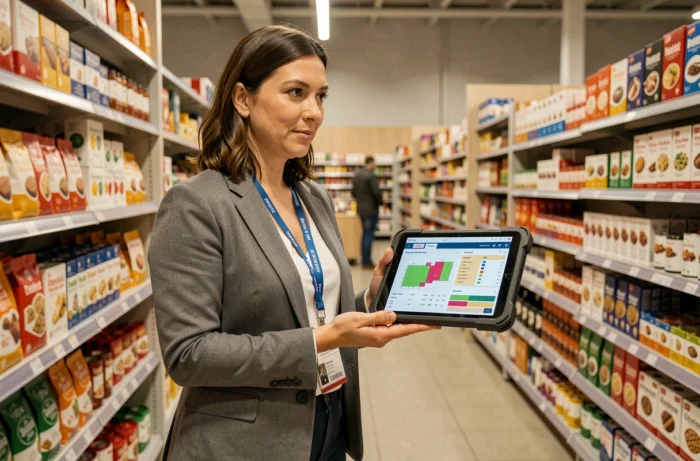
In a hypermarket, a shelf that remains empty for an hour in the middle of the day costs a lot. It’s not a stock issue; it’s an information issue: no one knows in real-time which shelf needs to be restocked. This is precisely where the Pilot Birdy system changes the game for Auchan, by connecting the physical shelf to a digital layer capable of providing data that can be utilized by in-store teams.
Sensors and interactive screens at the end of the aisle: what Pilot Birdy concretely installs
The Pilot Birdy shelf relies on a combination of sensors integrated into the shelves and interactive screens positioned at eye level. The sensors detect the presence or absence of products on the shelf. The screens display contextual information: product details, complementary suggestions, active promotions.
We are far from a simple digital display stuck on a piece of furniture. The architecture of the shelf is designed so that each shelf becomes a data collection point. When a customer takes an item, the system records the movement and updates the status of the shelf. The team in the aisle receives an alert when the restock threshold is reached, even before the customer notices an empty spot.
An article detailing the digital revolution on Communication Entreprise describes how this system also allows for personalized displays based on shopping habits detected in-store, with real-time promotions tailored to customer flow.
Field data and stock management at Auchan: the short loop that changes restocking
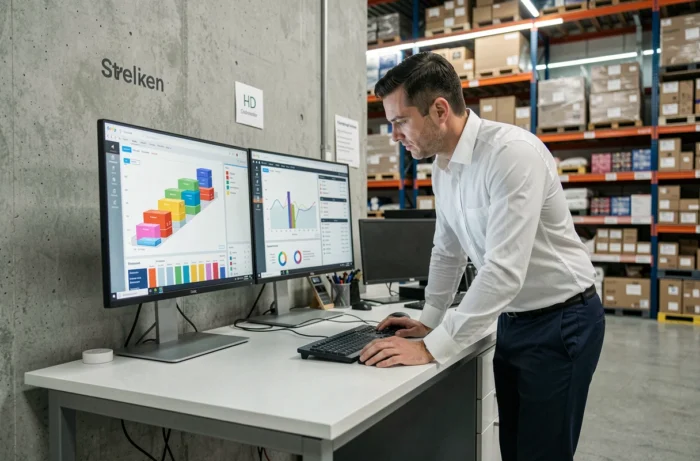
The real gain of Pilot Birdy is not visible to the customer. It takes place in the stockroom and on the teams’ planning. The data collected by the sensors feeds a dashboard that indicates, shelf by shelf, the products to be restocked as a priority. It is no longer the employee who makes a visual round; the system tells them where to go.
This short loop between the shelf and the stockroom reduces the time during which a location remains empty. For a hypermarket managing several tens of thousands of references, the difference is significant over a full day.
What the data reveals beyond restocking
The information collected is not only used to fill the shelves. It also informs assortment and merchandising decisions:
- The product uptake rate by time slot allows for adjusting the facing according to peak times
- The correlations between products taken together guide the placement of complementary references nearby
- The areas of the shelf least consulted on the interactive screens signal a visibility or relevance issue with the offer
We move from merchandising based on fixed planograms to adaptive merchandising driven by the actual behavior of customers in-store.
Pilot Birdy and Auchan’s digital transformation: a link in a broader chain
Pilot Birdy does not exist in isolation. Auchan has embarked on a transformation project that affects both the format of its stores and its upstream logistics flows. For example, the brand has robotized some return flows in its warehouses, in partnership with specialized providers. The digitization of the shelves fits into this logic: connecting the last meter (the shelf) to centralized management systems.
The network of stores itself is evolving. Auchan has completed the transformation of several of its French supermarkets, with changes in format and branding. The technology deployed on the shelf must adapt to the store that hosts it, not the other way around. A system like Pilot Birdy does not have the same impact in a peripheral hypermarket as in a smaller urban supermarket.
Comparison with other approaches to digital shelf tracking
Auchan is not the only retailer digitizing its shelves. Some brands have tested mobile robots equipped with cameras and image recognition to scan the shelves and detect out-of-stocks. This type of solution (deployed notably in Portugal by Auchan with Trax robots) is based on a different principle: the robot travels the aisles at regular intervals, whereas Pilot Birdy captures information continuously from the shelf itself.
The two approaches do not meet the same need. The mobile robot covers a wide area but has a delay between passes. The sensor embedded in the shelf offers instantaneous information retrieval, but assumes a heavier investment per linear meter. The choice depends on the store format and the density of references to monitor.
Customer experience in Auchan stores: what changes daily
From the customer’s perspective, the interactive screen of the Pilot Birdy shelf partially replaces the need to search for a salesperson or scan a barcode with their phone. The information displayed covers product composition, reviews, available alternatives, and ongoing promotions.
The most tangible point remains the reduction of visible out-of-stocks. A full shelf inspires confidence. An empty shelf pushes the customer towards a competitor or online shopping. Pilot Birdy impacts perceived availability as much as actual availability.
The current limitation lies in the coverage of the system. Not all shelves in a store are equipped simultaneously, and deployment varies by location. The experience can therefore differ significantly from one Auchan store to another, depending on the progress of the local digitization program.
The smart shelf does not replace the in-store employee. It provides them with a finer management tool and frees up time for customer advice rather than for visual verification rounds. This is probably where the real profitability of the system lies: not in the technology itself, but in the reallocation of human time it enables.