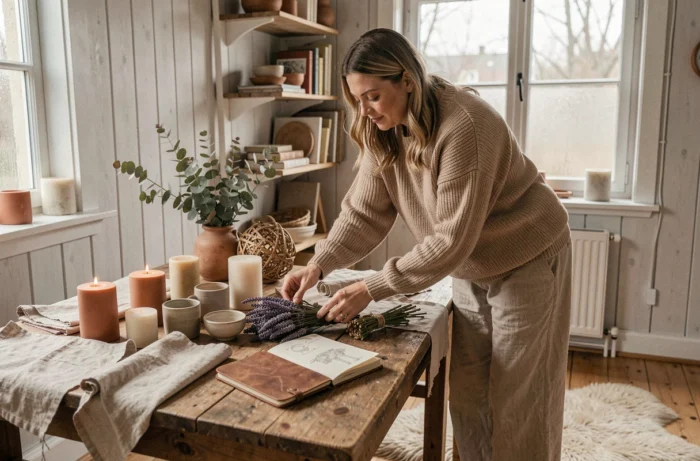
Hygge, this Danish philosophy of domestic well-being, has far surpassed the stage of a passing decor trend. Creating a hygge decoration workshop at home involves concretely transforming one’s interior by working on light, materials, and the arrangement of micro-spaces. The exercise is not limited to accumulating candles and throws: it requires understanding how each choice influences the actual comfort of a home.
Natural light and luminous rituals: the forgotten angle of hygge
Decor guides systematically associate hygge with a dim ambiance, lit candles, and indirect lighting. This interpretation is incomplete. Natural light plays a central role in daily well-being, and a hygge workshop at home benefits from integrating this parameter from the start.
Before thinking about light fixtures, it is essential to observe one’s home: window orientation, hours of sunlight, external obstacles. A practical exercise involves mapping out the areas of natural light room by room, then organizing living spaces around these zones.
Rather than betting everything on candles in the evening, a hygge decoration workshop at home can plan light rituals suited to the time of day: opening curtains wide in the morning, positioning oneself near windows for manual activities, then switching to warm, low lighting in the evening.
The management of blackout options is as important as the choice of lamps. Light linen curtains allow filtering without blocking. Adjustable blinds offer precise control depending on the season. In summer, overheating from direct sunlight can make a cozy space quite uncomfortable: planning modulation solutions avoids having to choose between visual warmth and actual thermal comfort.
Biophilic design and hygge decoration: connecting nature and interior
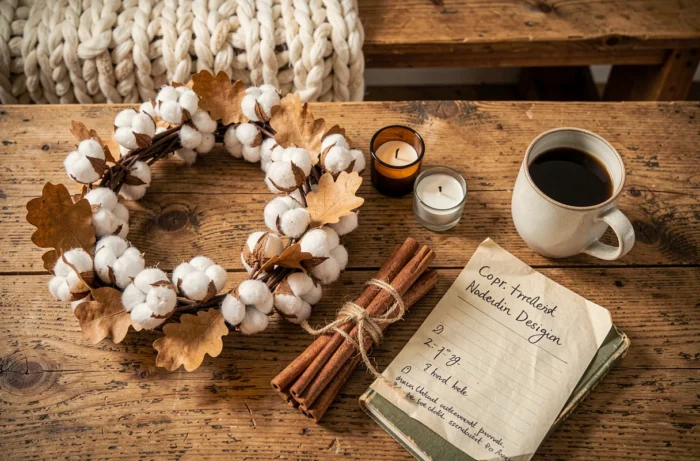
Decor articles mention wood, wool, and green plants. They rarely describe why these elements work. The link lies in biophilic design, an approach that integrates natural elements into interior spaces to enhance the well-being of occupants.
In a hygge decor workshop, this connection translates into concrete choices:
- Favor raw and unprocessed materials (solid wood, stone, artisanal ceramics) rather than their plastic imitations, which create a visual effect without offering the same texture to the touch
- Incorporate living plants, not just decorative: plants that evolve with the seasons, that are watered and pruned, create an active relationship with nature indoors
- Work with layered textures (linen, boucle wool, thick cotton) to stimulate the sense of touch, a dimension often neglected in favor of the visual alone
- Use colors inspired by natural palettes: earthy tones, off-white, sage green, blue-gray, rather than saturated shades or clinical whites
The 2024-2025 trend confirms this convergence between cozy style and biophilia. The interiors that work best in terms of perceived comfort are not those that accumulate the most decorative objects, but those where each natural element serves an identifiable sensory function.
Creating a hygge corner: arrangement and micro-spaces in the living room
The concept of “nook” appears in all content on the subject, but explanations remain vague. Concretely, a hygge decoration workshop must address the question of spatial arrangement methodically.
A cozy corner works when it is defined without being closed off. A bench under a window, an armchair placed at an angle with a small side table, a rug that marks a distinct area on the floor from the rest of the room: these setups create a feeling of enclosure without reducing space.
The size of the home is not an obstacle. In a studio or small living room, a simple change in localized lighting (a low table lamp, a warm temperature fairy light) is enough to distinguish a cocooning space from the rest of the room. The furniture does not need to be imposing: a thick floor cushion, a throw placed on the armrest of an existing sofa, a stack of books within reach.
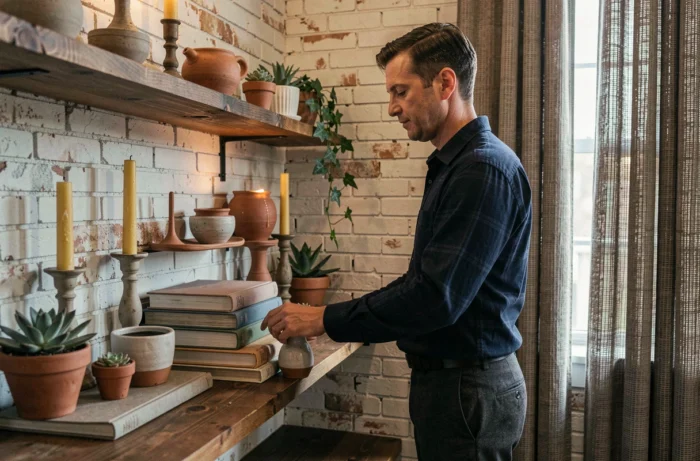
A common mistake is to want to transform everything at once. An effective DIY workshop focuses on one corner per session. You choose the location, test several configurations, adjust the lighting, and then live with it for a few days before making any changes.
The question of Danish style versus generic cocooning
Danish hygge is based on simplicity and functional minimalism. French cocooning tends towards accumulation: cushions, scented candles, multiple decorative objects. These two approaches do not produce the same result.
Authentic hygge style favors few objects, but chosen with care. One artisanal ceramic candle holder rather than five industrial candles. One natural wool throw rather than three synthetic blankets. This logic of “less but better” requires a sorting process that the workshop can integrate as a standalone exercise.
Color palette and cozy ambiance: what really works
Neutral and soft colors appear in all hygge guides, rightly so. However, the way to combine them is rarely explained.
A coherent hygge palette is based on a simple principle: a light base, two complementary tones, one discreet accent. For example, off-white walls, light wood furniture, textiles in warm beige and gray tones, and a single element in a more pronounced color (a forest green cushion, a terracotta vase).
Subtle patterned wallpaper (fine stripes, tone-on-tone geometric patterns) can replace paint on one wall to add depth without breaking the ambiance. Matte finishes are preferable to glossy finishes, which create harsh reflections that are not compatible with the desired atmosphere.
The coherence of the palette matters more than the choice of an isolated color. An interior composed of five close shades in the same color family will always appear more soothing than a space where each object introduces a different hue, even if each is individually “cozy”.
Hygge is not a fixed style to be reproduced exactly. It is a framework that encourages questioning each element of one’s interior from the perspective of actual comfort, not presumed comfort. A successful workshop leaves participants with tested choices adjusted to their own space, not with a standard shopping list.