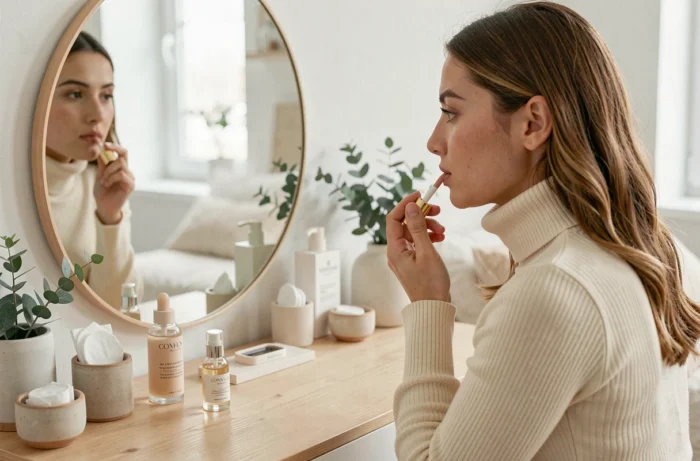
The beauty trends of 2024 are not just a handful of viral products on social media. Two European regulatory movements are simultaneously reshaping what brands can formulate and what consumers find on the shelves. Understanding these constraints helps to sort sustainable trends from fleeting fads.
European Beauty Regulation 2024: Retinol and Microplastics Under Pressure
Two regulations are concretely changing the composition of skincare and makeup sold in Europe. Their impact on beauty routines goes far beyond legal frameworks.
| Regulation | Reference | Products Affected | Practical Consequence |
|---|---|---|---|
| Retinol Restriction | Regulation (EU) 2024/996 | Face care, eye contour, body creams | Capped concentration, mandatory warning on the label |
| Microplastics Restriction | Regulation (EU) 2023/2055 | Rinse-off cosmetics first, makeup and nail products last | Progressive reformulation, staggered transition timeline |
The regulation (EU) 2024/996 caps the concentration of retinol in cosmetics and imposes a warning on the label. Highly dosed serums that were freely circulating will need to be reformulated or withdrawn.
Regarding microplastics, the regulation (EU) 2023/2055 targets intentionally added microparticles of synthetic polymers. Rinse-off cosmetics (shower gels, scrubs) are affected first. Makeup, lip products, and nail polishes benefit from the longest transition period.
A point often misunderstood: the restriction targets specific microparticles, not all polymers or film-forming ingredients used in cosmetics. Therefore, claims of “microplastic-free” on packaging do not mean “polymer-free.” This distinction helps avoid overinterpreting reformulation announcements.
To track these developments product by product, several specialized media compile reformulations brand by brand. The new sheets published on the Blog Beauté en détail website allow for cross-referencing updated compositions with recent regulatory requirements.
Skincare Trends 2024: What Regulation Changes in Your Routine
The restriction on retinol does not eliminate the active ingredient; it redistributes the cards. Brands that formulated at high concentrations must offer alternatives or adjust their dosages.
Three direct consequences for skincare routines:
- Retinol serums sold in Europe will show lower concentrations, reducing the risk of irritation for sensitive skin but may disappoint users accustomed to high dosages.
- Alternatives to retinol (bakuchiol, biomimetic peptides) are gaining visibility in reformulated ranges, although their long-term effectiveness is not documented at the same level as retinol.
- The mandatory warning on the label encourages consumers to read the composition, promoting a more informed approach to skincare.
Retinol remains allowed, but at reduced concentration. Therefore, the skincare trend for 2024 is not the abandonment of this active ingredient, but a transition to better-regulated formulas.
Makeup and Manicure Trends 2024: Glitter Under Surveillance
The microplastics restriction timeline directly affects two trendy product categories: glitter eyeshadows and metallic nail polishes.
Conventional glitters are often made from microparticles of synthetic polymers. The transition period for makeup and nails is the longest under regulation (EU) 2023/2055, meaning current formulas will remain on sale for several years. Brands are still anticipating by testing bio-sourced or mineral glitters.
The trend for metallic shades on nails, very prominent on runways and social media, largely relies on pigments and mirror-effect topcoats. Not all of these products are affected by the restriction: only those containing intentionally added microparticles of synthetic polymers fall within the scope of the regulation.
Checking the ingredient list remains the only reliable way to know if a product is affected. Marketing claims (“clean,” “eco-friendly”) do not correspond to any regulatory definition.

Holistic Beauty Routine: Underlying Trend or Marketing Argument
Several competitors are highlighting the “holistic routine” as a key trend for 2024. The idea is based on integrating overall well-being (nutrition, sleep, stress management) into the beauty routine, beyond just the products applied to the skin.
This approach is not new. What changes in 2024 is the proliferation of ranges that combine a dietary supplement with a topical treatment, sold together as a “system.” The consumer pays for two products instead of one, without the superiority of the duo over the single treatment being systematically demonstrated.
The holistic approach makes sense when it is based on verifiable habits (hydration, daily sun protection, sufficient sleep). It becomes a marketing argument when it is only used to justify a higher average basket.
Framework for Filtering Sustainable Beauty Trends
Not all beauty trends of 2024 are equal. Some are based on regulatory or scientific developments, while others rely on viral cycles that fade within months.
- A trend linked to a regulatory change (retinol, microplastics) permanently alters the available offerings on the shelves. It does not depend on an algorithm.
- A trend driven solely by a social network (viral nail art, celebrity-inspired looks) has a lifespan tied to the content cycle of the platform.
- Skincare trends related to formulation last longer than makeup trends related to aesthetics because they touch on the very composition of products.
The best framework remains to check whether a trend alters what the product contains or just how it is presented. In 2024, the two European regulations on retinol and microplastics fall into the first category. The rest is a matter of personal choice.