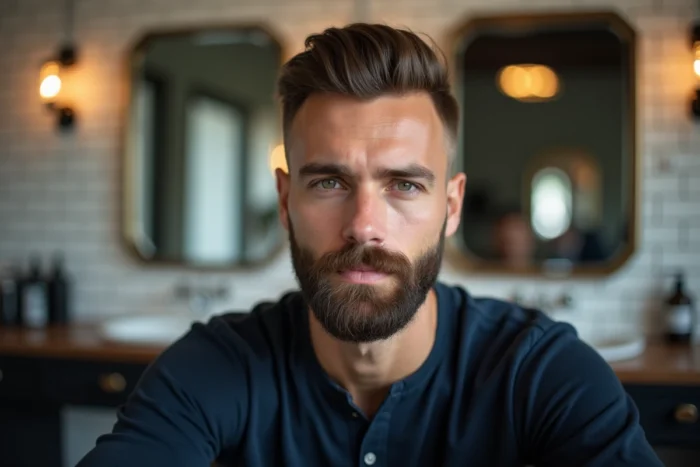
The collar beard is making a comeback in a form that its 19th-century followers would not recognize. Where the classic style drew a thick band along the jawline, current versions play on the precision of the line, the length of the hair, and the connection with the haircut. This revival deserves attention because it changes the way to choose and maintain this style.
High Definition Collar Beard: The Short Version That Stands Out
You may have noticed these very short beards, almost stubble, but with perfectly sharp jawline contours? This is the high definition collar. The hair length is between 0.5 and 2 mm, trimmed with a clipper using a fine guard. The result gives a structured effect without volume.
What distinguishes this variant from simple “stubble” is the precisely sculpted neckline. The lower contour follows the jawbone, then descends to the chin, forming a sharp line. The cheeks are closely shaved, creating a stark contrast between bare skin and hairy areas.
Specifically, this cut works well on oval faces or already defined jaws. It accentuates the angularity of the lower face. On a round face, it helps create an illusion of structure, provided that the neckline is placed just above the natural fold, not too high or too low.
To explore collar beard cuts for men in their current variations, the choice depends as much on the face shape as on the time one is willing to invest in maintenance.

Faded Transition Between Hair and Collar Beard: A Strong Trend
The most visible trend this year concerns the connection between the haircut and the beard. Rather than treating the two separately, barbers now work on a gradual fade from the sideburns to the collar.
The idea is simple. The fade of the haircut no longer stops at the temple. It extends towards the sideburns and then connects to the collar beard line. The transition is smooth, without a harsh demarcation between the shaved area and the hairy area.
Why This Choice Changes the Overall Look
An isolated collar beard, without a link to the hairstyle, can give a rather artificial “stuck-on” effect. When the fade connects the two, the face gains coherence. The eye perceives a natural continuity rather than two elements placed side by side.
This transition work requires a visit to the barber every two to three weeks. Between appointments, a clipper with several guards allows for maintaining the fade. The shortest guard goes on the sideburns, the longest on the chin.
Maintaining the Collar Beard: The Actions That Make a Difference
A poorly maintained collar beard loses its effect in just a few days. The hairs grow back unevenly, the contours blur, and the style quickly shifts to a messy stubble. A few regular actions can prevent this outcome.
- Redefine the contours every two days with a precision razor or a clipper without a guard, following the natural line of the jaw.
- Apply a light beard oil to the chin and neck area to soften the short hair and prevent irritation, especially on sensitive skin.
- Exfoliate the skin under the collar once or twice a week to limit ingrown hairs, a common issue with very short beards and closely shaved contours.
Ingrown hairs are the main enemy of the collar beard. The shorter the hair and the more frequent the shaving, the greater the risk increases. A gentle scrub and shaving with the grain (never against the grain on the neck) significantly reduce this problem.

Clipper or Razor: Which Tool Depending on the Chosen Variant
For a high definition collar (less than 2 mm), a precision clipper is sufficient. Models with a fine blade allow for sharp lines without needing a razor.
For a more pronounced collar, with a length around 5 mm and more, the duo of clipper with guard and safety razor works better. The clipper manages the length, while the razor cleans the peripheral areas (cheeks, neck under the line).
Collar Beard Without Mustache or With: Two Distinct Styles
By definition, the classic collar beard does not include a mustache. It is, in fact, the only beard style traditionally worn without hair above the lip. Lewis Hamilton and Stormzy have helped bring this version back into fashion.
The variant with a connected mustache also exists. It transforms the collar into a complete facial contour, closer to the American “strap.” The result is different: the face appears more framed, sometimes more severe.
- The collar without a mustache suits oval faces and strong jaws. It emphasizes the lower part of the face.
- The collar with a connected mustache softens elongated faces. It rebalances proportions by adding volume to the middle of the face.
- A thin collar (type “pencil”) without a mustache gives a very graphic, almost drawn look. It requires great precision in trimming.
The choice between these variants mainly depends on the shape of the face, not just an aesthetic preference. A thin collar on a wide face may appear disproportionate. A thick collar on a narrow face risks weighing down the features.
The collar beard has little in common with the unique style it was once associated with. Between the ultra-short high definition version, the connected fade to the haircut, and the variants with or without a mustache, it is a style that adapts according to face shape and the level of maintenance one is willing to undertake. The best approach is to try a simple version at a barber before committing to a daily routine.