
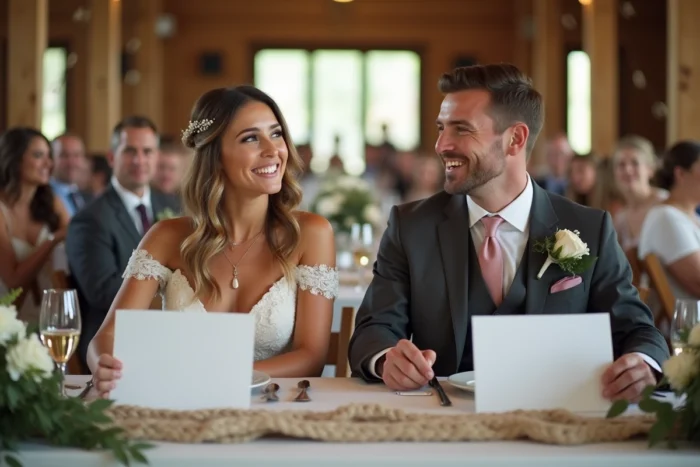
The game Mr. and Mrs. at the wedding is based on a simple principle: the newlyweds, sitting back to back, hold up a sign to answer questions about their couple. Guests find out in real-time whether the answers match or contradict each other. The discrepancy between the two answers creates a comedic effect, but the success of the activity depends less on the concept itself than on its preparation in advance.
Validation of questions before the big day: a filter that has become the norm
Practices have changed in recent years. Where witnesses used to improvise questions on the same evening, the current trend requires a systematic review by the newlyweds before the reception. This evolution comes from numerous feedback pointing out the awkwardness of certain overly intrusive questions.
Topics to avoid are identifiable: ex-partners, couple disputes, financial questions, fertility. These themes, posed in front of a gathering of family and friends, can create a lasting discomfort that neither humor nor alcohol can dissipate. To discover Nuptialement for a successful wedding, this validation step is the first reflex to adopt.
The filter works both ways. Some questions may seem harmless on paper but touch on a sensitive point known only to the newlyweds. Conversely, questions that seem bold may be perfectly accepted by the couple. Only the newlyweds can decide.
Duration and rhythm of the Mr. and Mrs. game during the meal
A quiz-style entertainment game should not exceed ten to fifteen minutes, including rules. Beyond that, guests’ attention wanes and the rhythm of the meal breaks. This time constraint changes the way the list of questions is conceived.
With such a short duration, every question counts. It’s better to prepare eight to ten impactful questions than a list of twenty-five questions where half yield predictable answers. The sorting is done by eliminating questions with obvious answers (the ones everyone guesses) and those that require a long explanation before being understood.
Placing the activity at the right moment during the meal
The Mr. and Mrs. game fits between two courses, never during dessert or after the first dance. Collective attention is at its peak between the starter and the main course. After cheese, guests get up, chat between tables, smoke outside. The activity loses its impact as soon as the assembly disperses.
A point confirmed by feedback from the field: if the evening includes several games, the Mr. and Mrs. game is best placed first. It puts the newlyweds at the center without requiring physical effort or active participation from the guests, making it a good start before more participative activities.
Questions for the Mr. and Mrs. game: what really works
Lists of fifty questions found everywhere online share a flaw: they are generic. “Who is the most stubborn?” or “Who cooks the best?” produce expected answers and few laughs. The best questions exploit a couple-specific anecdote.
To achieve this level of personalization, the host (often a witness) must collect stories in advance from close friends and family. A question like “Who suggested adopting the cat while the other was allergic?” works because it refers to a real event that close guests know and others discover.
Three categories of questions that provoke reactions
- Questions about embarrassing daily habits (who leaves their socks lying around, who monopolizes the remote), because the discrepancy between the public answer and reality amuses everyone
- Questions about the couple’s meeting and beginnings (who made the first move, who lied about their age), because they bring up memories that even close friends may not always know
- Projective questions about the future (who will want another pet, who will mention moving first), because they spark mini-debates live between the newlyweds
The order of questions is also important. Start with light and consensual questions, then build up to more revealing ones. Ending with a tender question rather than an awkward one leaves a positive impression on the assembly.
Variations of the Mr. and Mrs. game to surprise guests
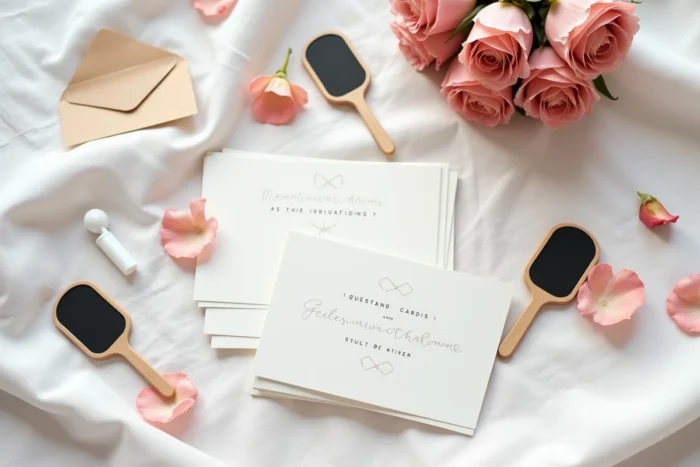
The classic format (signs, back to back) remains effective, but several variations allow for refreshing the activity, especially when guests have already attended this game at other weddings.
The first variation involves reversing roles: it’s the guests who answer questions about the newlyweds, by tables. Each table holds up a sign, and the newlyweds reveal the correct answer. This format transforms a passive activity into a competition between tables and involves all guests in the game.
The second variation mixes the Mr. and Mrs. game with a blind test. Between two questions about the couple, a few seconds of a song related to their story is played. Guests must guess the connection between the song and the couple. This crossover between a musical quiz and a couple’s game breaks the monotony of a single format.
A third option, more discreet, involves a paper support distributed on the tables: each guest fills in their own answers before the newlyweds reveal theirs. The results are compared aloud. This version is better suited for weddings where the newlyweds prefer not to be alone on stage for fifteen minutes.
What causes the Mr. and Mrs. game to fail at a wedding
The most common failure comes from the microphone. Without proper sound equipment, guests at the back of the room cannot hear either the questions or the reactions of the newlyweds. The game becomes a silent show for half the assembly. Checking the audio equipment before the start of the activity avoids this common but recurring problem.
The choice of the host is as crucial as the questions themselves. A witness who is too shy leaves awkward pauses between questions. An overly intrusive host turns the game into a one-man show where the newlyweds become background characters. The host asks the question, lets silence settle, then briefly comments on the answer without monopolizing attention.
The last factor of failure remains the duration. A game that stretches beyond fifteen minutes loses its audience, even with excellent questions. It’s better for guests to ask for more than for them to wait for it to end.