A candidate rejected on Parcoursup in June, an adult retraining who discovers 3D animation after a first career, a high school student whose academic record does not reflect their drawing level: these three profiles share the same constraint. The national platform offers only a fraction of the training programs in animation, and many specialized schools recruit outside of this circuit.
Understanding their admission procedures, the real weight of the artistic portfolio, and the funding pitfalls can save several months on a training project.
RNCP Title and Recognition: The Real Filter Before Applying
It is often said that “outside Parcoursup” means “not recognized.” The reality is more nuanced. What matters for an employer or public funding is the registration of the diploma with the RNCP, not the school’s presence on the national platform.
Since 2024-2025, several 3D animation schools have consolidated this strategy. IIM Digital School, for example, offers a Bachelor in 3D Animation accessible post-bac and through parallel admissions, explicitly outside Parcoursup, with titles registered with the RNCP at levels 6 and 7 for the entire 3D animation and VFX program. An RNCP title at level 6 corresponds to a bachelor’s degree, while level 7 corresponds to a master’s degree.
Before submitting an application anywhere, two things should be checked: the RNCP sheet number (available on the France Compétences website) and its validity date. An expired or renewing title undermines the entire value of the diploma. If the school refuses to provide this number, it is a concrete warning sign.
For those who want to enter a 3D animation school outside Parcoursup, this RNCP verification is the first step, well before preparing a portfolio or attending an interview.
Artistic Portfolio in 3D Animation: What Jurors Really Evaluate
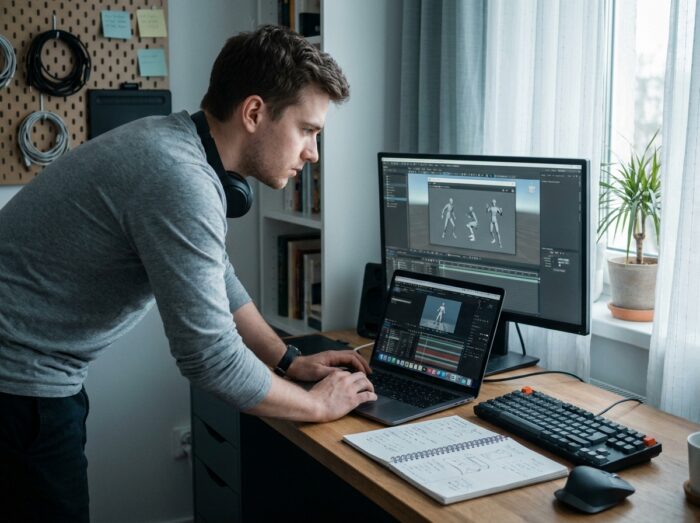
On Parcoursup, selection largely relies on grades and the motivation letter. Schools outside the platform operate differently: the artistic portfolio (book, demo reel, or digital portfolio) carries more weight than the final year report card.
An admission jury for an animation school looks for three specific things:
- The ability to observe, demonstrated by sketches from life, studies of movement, or even basic anatomy boards
- A narrative intention, visible in a storyboard, a short personal project, or an animated sequence, even created with free tools like Blender
- The progression and consistency of the work, rather than a single highly polished piece that may have been completed with outside help
Demonstrating a creative process matters more than a perfect final render. Schools want candidates who can iterate, receive critical feedback, and make corrections. A ten-page book with personal annotations on mistakes is often worth more than a polished portfolio of thirty boards without commentary.
Feedback on this point varies among juries, but the general trend favors the sincerity of personal work over raw technical mastery. A candidate who shows their rough research, failed tests, and final version tells a coherent production story.
Timeline and Parallel Admissions: When to Apply Outside Parcoursup
One of the concrete advantages of training outside Parcoursup is the flexibility of the timeline. While the platform imposes fixed phases (applications in January, responses in June), independent schools often open multiple admission sessions between November and September.
Some schools like ISART offer parallel admissions for students already engaged in a first cycle (BTS, university degree, another school). This mechanism allows joining a 3D animation program in the second or third year without starting from scratch, provided a compatible skills base is justified.
In practice, three windows are distinguished:
- Early sessions (November to February), which offer the most available places and sometimes specific scholarship conditions
- Main sessions (March to June), which concentrate the majority of applications and where selection is tighter
- Complementary sessions (July to September), aimed at profiles in retraining or candidates rejected elsewhere, with residual places
Applying early does not guarantee admission, but it allows time to prepare a solid motivation interview and to enhance the portfolio if the initial feedback is mixed.
Funding for 3D Animation Training Outside Parcoursup
Cost remains the main barrier. Private 3D animation schools outside Parcoursup have tuition fees per semester that are significantly higher than those of public training. Two concrete levers can help reduce the bill.
Alternating work in the third year of the bachelor’s program is now offered by several schools (IIM, ISART, among others). The apprenticeship contract covers training costs and provides a salary. For production studios and VFX companies, hiring an apprentice trained in their pipeline represents a profitable investment: the candidate is already familiar with the studio’s tools and workflows.
The second lever concerns professional training funding mechanisms. A candidate in retraining can use their CPF if the targeted title is properly registered with the RNCP. Regions also offer specific assistance for job seekers who enroll in a certifying training program in digital or creative professions.
The combination of a validated RNCP title and an apprenticeship contract remains the most favorable configuration for financing a complete 3D animation program without incurring debt over several years. Checking these two elements before signing a tuition contract avoids unpleasant surprises during training.
The animation market in France continues to absorb profiles trained in special effects, modeling, and 3D production management. Studios seek operational skills on specific pipeline software, not a Parcoursup stamp. What differentiates a selected candidate from a rejected one is the quality of the portfolio, the coherence of the professional project, and the solidity of the obtained title.