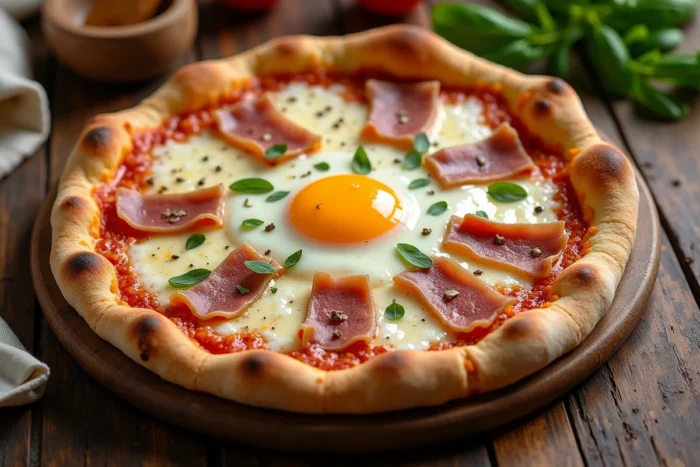
When you order a carbonara pizza at a French pizzeria, you almost always receive a cream base, lardons, mozzarella, and a broken egg on top. In Italy, this combination is frowned upon. Traditional carbonara contains no cream: its creamy texture comes solely from the emulsion of eggs, pecorino, and the pasta cooking water. Translating this dish onto a pizza therefore requires making choices, and these choices are divisive.
Cream or no cream on a carbonara pizza: the real debate
The point of contention boils down to one word: the base. On pasta, the carbonara sauce relies on a mixture of eggs and cheese that emulsifies when it comes into contact with hot starch. On a pizza, this technique does not work the same way. The pizza dough has no cooking water to offer, and the heat of the oven causes the egg to coagulate very quickly.
Most pizzerias circumvent the problem by spreading fresh cream or mascarpone as a white base. The result is rich and indulgent, but it has little to do with orthodox carbonara. Italian chefs and media have been denouncing the addition of cream to any dish called “carbonara” as a culinary sacrilege for several years now.
This can be seen as excessive purism or a useful reminder. What is certain is that French carbonara pizza is a hybrid dish, openly acknowledged as such by the establishments that offer it. To understand this indulgent stance, one can look at the carbonara pizza Del Arte on 3 Coups 2 Fourchette, which details the composition of a version that fully embraces the creamy base and runny egg.
Guanciale, pancetta or lardons: the choice of charcuterie changes everything
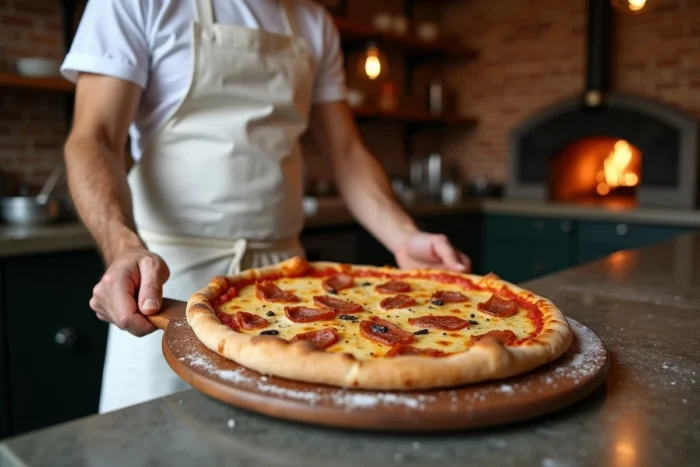
The canonical Italian recipe uses guanciale, dried pork cheek. On a pizza, you more often find pancetta or simple smoked lardons. The difference is not trivial.
Guanciale melts slowly and releases a flavorful fat that permeates the dough. Pancetta provides a rounder, less intense flavor. Smoked lardons, on the other hand, add a woody note that does not exist in the Italian version.
- Guanciale gives the result closest to classic carbonara, with a melting fat and a pronounced pork flavor.
- Pancetta works well for palates that find guanciale too intense, while still remaining within an authentic Italian range.
- Smoked lardons are the most common choice in France, due to convenience and habit, but their smoky aroma can overshadow the flavors of the cheese and egg.
For a homemade carbonara pizza, it’s beneficial to pre-cook the charcuterie in a pan before placing it on the dough. Simply baking it in the oven may not always make the guanciale or pancetta crispy, especially if the cooking is quick.
Cooking the egg on carbonara pizza: the technical detail that makes the difference
The egg is the most delicate element to master. The goal is a set white and a still-runny yolk, so it serves as a natural sauce when pierced at the table. In practice, feedback varies on this point: depending on the oven, the position of the egg, and the thickness of the dough, the result ranges from perfectly creamy yolk to overcooked yolk.
When to break the egg on the pizza
Adding the egg at the very beginning of cooking ensures a well-set white but often a fixed yolk. The technique that yields the best results is to bake the pizza without the egg, then break it on top halfway through cooking. In a home oven set to maximum, this represents the last few minutes before taking it out.
Another rarely mentioned point concerns food safety. For pregnant women or immunocompromised individuals, the egg must reach a sufficient internal temperature. A runny yolk does not guarantee this. In this case, it is better to cook the egg completely or omit it.
Cheese on carbonara pizza: parmesan, pecorino or both
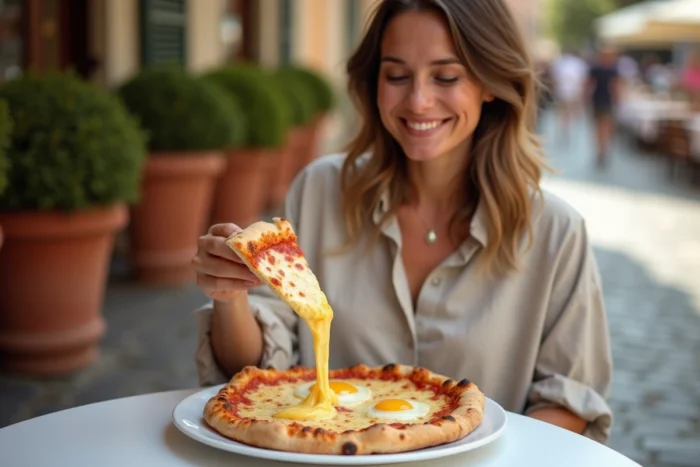
Traditional carbonara uses pecorino romano, a sheep’s cheese with a salty and tangy flavor. Many French pizzerias replace it with parmesan, which is milder and easier to find.
The two cheeses behave differently in the oven. Pecorino tends to form dry crusts if exposed to heat for too long. Parmesan melts more evenly and browns better.
The best option for a homemade carbonara pizza remains to mix pecorino and parmesan in equal parts. Pecorino brings the distinctiveness, while parmesan adds roundness. They are finely grated and added in two stages: part before cooking (for browning), part after taking out of the oven (for aroma).
mozzarella: necessary or superfluous
Many recipes add mozzarella, sometimes even burrata. This choice results in a more stretchy and visually appealing outcome, but it dilutes the flavors of the carbonara under a layer of neutral cheese. If the base is already creamy, mozzarella weighs it down.
On a thin crust with a light cream base, mozzarella becomes optional. It can be omitted without making the pizza seem dry, provided that the aged cheese (parmesan or pecorino) is present in sufficient quantity.
Table pairings: wine and complementary toppings
Carbonara pizza has a rich and salty profile that calls for a wine with good acidity. A dry, crisp Italian white works well. Light reds, served slightly chilled, also hold up nicely.
As for toppings, freshly ground black pepper is non-negotiable: it is a pillar of carbonara. A few leaves of arugula placed after cooking provide a welcome bitter contrast on such a rich pizza.
Carbonara pizza remains a dish of assembly where each component has a specific role. Removing the cream, changing the charcuterie, or cooking the egg differently each time yields a distinct result. It is this latitude that makes it a recipe as widespread as it is controversial on Italian and French tables.