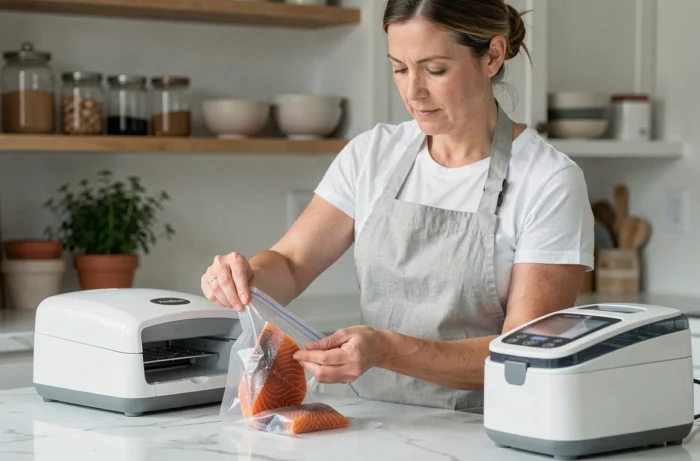
Your FoodSaver FFS005 is set on the countertop, the roll is in place, but you’re unsure about the right setting for packaging moist foods. This doubt often arises, and the answer can be found in specific pages of the reference guide that comes with the device. This article breaks down the points in the manual that raise the most questions, and goes further on a topic that the manual does not address: the actual compatibility of consumables in 2026.
Settings of the FoodSaver FFS005 According to Food Type
The FFS005 offers two distinct sealing modes. The first, intended for dry foods (pasta, cereals, coffee), applies continuous suction until almost all the air is extracted. The second, designed for moist foods (marinades, fresh meats, saucy dishes), reduces the suction power to prevent liquid from rising into the channel and damaging the seal.
Have you ever noticed a seal that doesn’t hold after a few days in the freezer? In most cases, the problem stems from a poor choice between these two modes. A leftover sauce packaged in “dry” mode sucks liquid into the sealing area, preventing the seal from fusing properly.
The device also includes four suction speeds, one of which is manual. The manual speed allows you to stop the suction by hand, which is useful for delicate foods (chips, toasts, berries) that you don’t want to crush. Before each use, consult the FoodSaver FFS005 manual to identify the pictogram associated with each speed on the control panel.

Maintenance of the Seal and Liquid Collector of the FFS005
The sealing gasket is the most stressed part of the device. After about ten cycles, microscopic food residues accumulate on the heating strip and the sealing foam. The manual recommends cleaning with a non-abrasive damp cloth after each extended session.
Never run the gasket under running water. Moisture trapped in the internal housing can cause short circuits or, more often, incomplete seals during the next session. A gentle wipe followed by air drying is sufficient.
The liquid collector, located under the suction channel, is removable. It can be washed with warm soapy water. The reference guide specifies to empty it as soon as it contains visible liquid, even in small amounts. Forgetting this step eventually clogs the suction mechanism and reduces vacuum power.
Check the Wear of the Heating Strip
The heating strip is not eternal. If your seals show irregular translucent areas instead of a uniform opaque line, the heating element is heating unevenly. The manual does not provide a fixed lifespan, but an irregular seal is the first sign of wear on the strip. Replacement is tool-free: you remove the old strip and clip the new one into the designated housing.
Bags and Consumables Compatible with the FoodSaver FFS005 in 2026
The original manual lists FoodSaver brand rolls and bags as recommended consumables. In practice, many users purchase third-party bags marketed as “FoodSaver compatible” to reduce the cost per bag. The question is no longer just about price, but also about regulatory compliance.
Not all “FoodSaver compatible” bags are created equal. Recent consumer guides remind us to check for the embossed texture (essential for suction to work in an external suction device like the FFS005), the declared compatibility with freezing and cooking, and the intended use. A smooth bag designed for a chamber vacuum machine will not create any vacuum in the FFS005.
New European Rules on Food Packaging
Since August 2026, new European rules on packaging and packaging waste have come into effect. These provisions particularly concern substances in contact with food. The European Union has also adopted a ban on bisphenol A (BPA) in materials intended for food contact, with transition periods currently in progress.
For a user of the FFS005, this concretely means that certain batches of generic bags manufactured before these new requirements may no longer be compliant. Here’s what to check before purchasing consumables:
- The explicit mention of compliance with food contact according to current European regulations, and not just a generic CE logo on the box.
- The absence of BPA in the composition, information that must appear on the packaging or the product sheet from the bag manufacturer.
- The embossed texture on at least one side of the bag, without which the suction channel of the FFS005 cannot extract air properly.
- The declared thermal compatibility: freezing (down to marked negative temperatures) and, if you practice sous vide cooking, prolonged heat resistance.
Using the Integrated Cutter and Roll Compartment
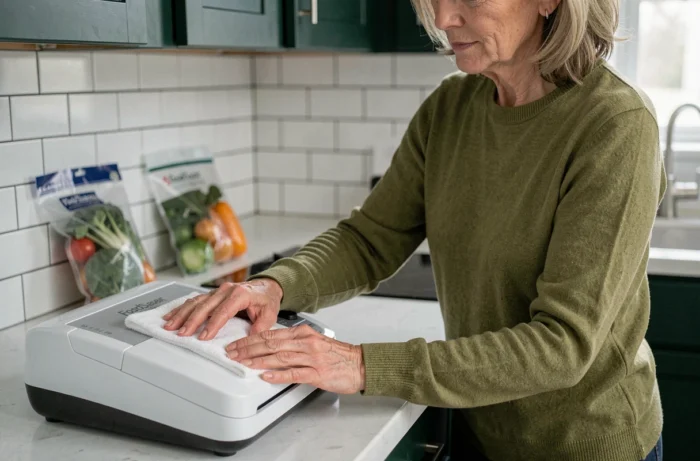
The FFS005 features a storage compartment for the roll with an integrated cutter. This function allows you to cut custom bags from a roll, reducing material waste compared to pre-cut bags.
The roll is placed in the rear housing, with the embossed side facing down. You pull the desired length (the manual recommends leaving about 75 mm of margin beyond the food), then slide the cutter slider to make a clean cut. Always seal the bottom of the bag before filling it: place the open end in the channel, start a sealing cycle only (without suction), then turn the bag over to slide in the food.
A common mistake is to fill the cut bag before sealing the bottom. The result is food that falls into a tube open at both ends, requiring you to start over and waste a piece of roll.
Independent Sealing Mode and Box and Jar Accessories
The FFS005 also offers a standalone sealing mode for FoodSaver boxes and jars. By connecting the hose accessory (sold separately or included depending on the kits), the device sucks the air out of a rigid container without using a bag. This mode is suitable for meal leftovers that you want to keep in the refrigerator for a few days without committing to freezing.
The manual specifies that jars must have a lid compatible with the FoodSaver suction nozzle. Standard screw-top glass jars do not work with this system, as the nozzle does not create a sufficient seal on a standard thread.
The FFS005 remains an accessible device that covers most domestic vacuum sealing needs. Reviewing the sections of the reference guide dedicated to choosing the suction mode avoids most sealing failures. Regarding consumables, checking the regulatory compliance of bags purchased in 2026 protects both the quality of preservation and food safety on a daily basis.