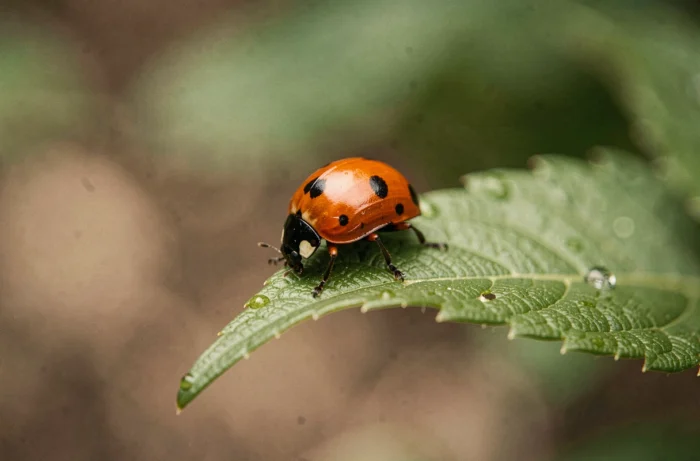
Have you ever seen an orange ladybug covered in black spots land on your window sill in autumn? There’s a good chance it’s an Asian ladybug, Harmonia axyridis. This insect fascinates as much as it disturbs. Behind the beliefs related to luck and divine protection, the reality of this species is much more nuanced than that of its European cousin with seven spots.
Harmonia axyridis: an insect with many faces
The Asian ladybug doesn’t always match the image we have of it. Unlike the classic red ladybug, it displays very variable colors: orange, yellow, red, and sometimes almost black. The number of spots also changes from one individual to another, ranging from zero to more than twenty.
A reliable marker for recognizing it: a black M-shaped mark on the white thorax. This detail distinguishes it from most indigenous European species.
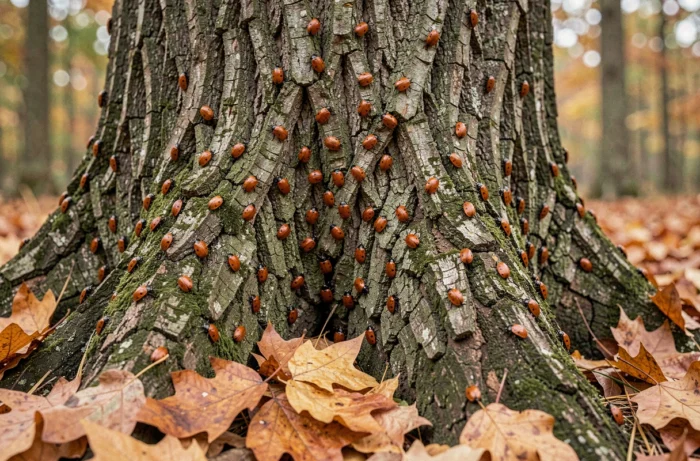
You may have noticed that in autumn, these ladybugs gather in groups of dozens, even hundreds, on the light facades of houses. They are seeking shelter to survive the winter. This gregarious behavior, absent in our local species, often surprises. It does not pose a direct danger to residents, but the Asian ladybug can secrete an unpleasant yellow liquid when it feels threatened.
To better understand the Asian ladybug and its spiritual significance, one must first grasp why this insect was introduced to Europe and what happened next.
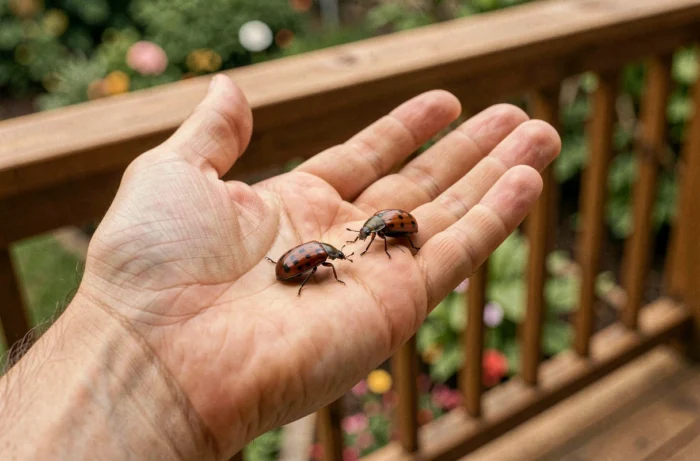
Asian ladybug and biological control: an invasive biocontrol
The story begins with good intentions. Harmonia axyridis was introduced to devour aphids in crops and gardens. It is voracious, larger, and more resilient than local species. On paper, it was the ideal solution to reduce pesticide use.
The problem is that it didn’t just eat aphids. Naturalists now cite it as a textbook case of biocontrol failure, where the effects on biodiversity were not sufficiently anticipated.
Its concrete impacts on nature are documented:
- It competes directly with native ladybugs for food, quickly occupying territories rich in aphids.
- It consumes the eggs and larvae of other ladybug species, measurably reducing their populations.
- It carries microsporidian parasites to which it is resistant, but which severely affect local species like the two-spotted ladybug (Adalia bipunctata).
The decline of the two-spotted ladybug has been documented in several European countries since the expansion of Harmonia axyridis. This is not a trivial detail: it is a warning signal for insect biodiversity in Europe.
Ladybug and beliefs: does the Asian ladybug bring good luck?
The nickname “God’s creature” has been associated with ladybugs since the Middle Ages. The most well-known legend dates back to the reign of Robert the Pious, around the end of the 10th century. A condemned man was said to have been saved by a ladybug that stubbornly landed on his neck, preventing the executioner from striking. The king saw it as a divine sign and pardoned the man.
This legend established a persistent belief: killing a ladybug would bring bad luck. In Eastern Europe, particularly in Lithuania and Croatia, a ladybug landing on you is believed to carry a message from a loved one. In China, it is associated with romantic luck.
However, these beliefs have been built around the classic seven-spotted ladybugs, the most widespread species in Europe for centuries. The Asian ladybug, which arrived much more recently, does not have the same aura in popular traditions. Its variable appearance, autumn invasions, and unpleasant defensive liquid make it more likely to be viewed with suspicion.
Spiritual significance: a transfer of symbol
Spiritually, many people apply the same meanings to the Asian ladybug as to the European ladybug: luck, protection, love, renewal. It’s a transfer of symbol. The insect is visually similar, and the human mind naturally associates the round, colorful shape with something positive.
The spiritual significance depends more on the perspective one has on the insect than on its species. If an Asian ladybug lands on your hand on a spring day, there’s nothing to stop you from seeing it as a sign of happiness. The belief belongs to the one who experiences it.
Red ladybug or Asian ladybug: how to distinguish them in the garden
Confusing the two species is common, but a few simple criteria allow for differentiation:
- The seven-spotted ladybug (Coccinella septempunctata) measures about six to eight millimeters, with a bright red color and exactly seven well-defined black spots.
- The Asian ladybug is slightly larger, with a color palette ranging from pale yellow to dark red, and a highly variable number of spots.
- The thorax of the Asian ladybug bears the famous M-shaped black mark on a light background, absent in most local species.
In the garden, both species consume aphids. The difference is that the Asian ladybug also eats the larvae of its European cousins. Encouraging hedges, meadows, and natural shelters helps native species withstand this competition.
The ladybug remains a symbol of vibrant nature and good garden health. Whether you see it as a spiritual sign or simply a useful ally against aphids, observing it closely allows for a better understanding of what is happening in the ecosystem, right before our eyes.