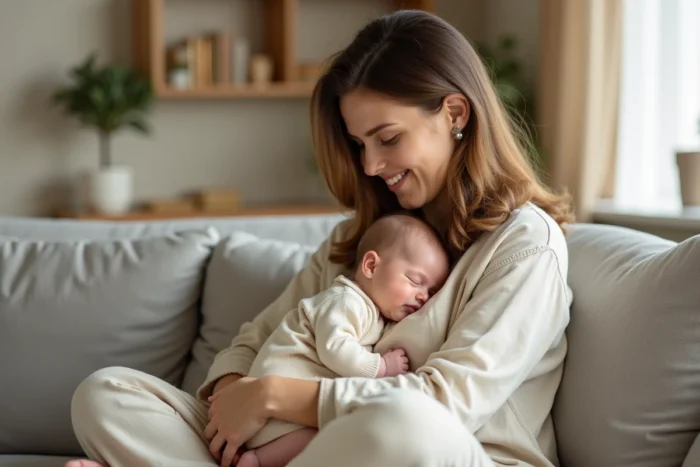
Sleep disturbances in infants are not just a temporary inconvenience. When nighttime awakenings multiply over weeks, parental fatigue accumulates and can become a real risk factor for the mental health of the entire family.
The Ministry of National Education and Youth now includes parents’ mental health in its information and guidance systems, with national listening numbers accessible at all times, such as 3114. This institutional framework shows that the issue of baby sleep goes far beyond domestic comfort.
Baby sleep and parental mental health: an underestimated link
Most online content about children’s sleep approaches the topic from the perspective of family well-being. The word “serenity” appears everywhere. This vocabulary masks a harsher reality: repeated fragmented nights weaken the psychological health of parents, not just their morning mood.
Chronic sleep deprivation in adults alters emotional regulation, decision-making ability, and patience. For a single parent or a couple already under professional pressure, repeated nighttime awakenings over weeks can lead to a state of exhaustion close to parental burnout.
Choosing to seek support from a baby sleep specialist is therefore a preventive measure, not a luxury. The issue is not just that the child sleeps through the night, but that parents retain the necessary resources to fulfill their daily roles.

“Cry it out” methods versus regulation approaches: what the debate reveals
The landscape of baby sleep advice remains marked by a deep divide. On one side, the so-called extinction methods (letting the child cry alone until falling asleep). On the other, approaches focused on the emotional regulation of the infant, which consider that the baby does not yet have the neurological maturity to calm down without external support.
Media-covered sleep specialists in France are now clearly positioning themselves against “cry it out” practices, deeming them contrary to the emotional regulation needs of the little one. This stance marks a break from the recommendations that were still widely circulated a few years ago.
A sleep consultant trained in current approaches does not propose a one-size-fits-all method applied to all babies. She assesses the overall situation of the family: nap rhythms, room environment, bedtime rituals, and parents’ fatigue levels. The personalized plan that results takes into account the child’s age, temperament, and the limits that parents are willing to set.
What personalized support concretely changes
Feedback from families receiving support converges on several recurring points:
- A visible improvement in nights within a few days to a few weeks, with a gradual reduction in nighttime awakenings
- Naps that lengthen and stabilize, restructuring the child’s day and freeing up time for parents
- A bedtime that shifts from a moment of tension to a predictable ritual, reducing anticipatory anxiety in both adults and children
The support does not aim to “train” a baby, but to identify the discrepancies between their physiological needs and the existing family habits. Sometimes, a simple adjustment of nap times or a modification of the light environment is enough to unlock the situation.
Baby sleep specialist: skills and limits of an unregulated profession
The profession of baby sleep consultant is not regulated by a state diploma in France. Several training organizations exist, with varying durations and content. This lack of regulation requires parents to do some verification work before committing.
The available data do not allow for an objective ranking of training programs. However, some criteria can filter serious profiles:
- A training program that includes modules on the physiology of children’s sleep, not just behavioral techniques
- A follow-up practice over several weeks (and not a single consultation with a standard plan)
- The ability to refer to a healthcare professional (pediatrician, ENT, osteopath) when sleep disturbances are due to a medical cause
- A clear stance on the methods used, explained before the support begins
A competent specialist knows how to recognize the limits of her field of intervention. Nighttime awakenings related to gastroesophageal reflux or chronic nasal obstruction cannot be resolved by routine adjustments. The consultant’s role includes sorting out what falls under support and what requires medical advice.

Sleep tracking apps and digital tools: complements or distractions
Apps like Livity now offer sleep tracking combined with health data. These tools allow parents to document cycles, nap durations, and nighttime awakenings with a precision that paper logs could not provide.
However, feedback on this point varies: some families find that digital tracking reassures them, while others report increased anxiety related to constant data monitoring. The digital tool does not replace the analysis of a professional capable of contextualizing the numbers within the overall development of the child.
A sleep consultant can use this data as a working tool, provided it remains one tool among others and not the cornerstone of the support. The risk would be to turn every micro-awakening recorded by a sensor into a source of concern, when it could be a perfectly normal phenomenon in the maturation of an infant’s sleep.
The decision to consult a sleep specialist for one’s child is best made early, before parental exhaustion becomes the main issue. Peaceful nights are not guaranteed by a miracle method, but by a nuanced understanding of each family’s needs, adjusted week by week.