You have just installed a wooden or tile terrace against your house. The work is complete, and you are already enjoying the space. But have you thought about notifying the tax authorities? Depending on the nature of your terrace, a tax declaration may be mandatory, and forgetting it exposes you to retroactive adjustments on your property tax.
Taxable or non-taxable terrace: the criterion that makes the difference
Not all terraces are treated the same. The tipping point can be summed up in one sentence: a terrace is taxable as soon as it cannot be moved without being demolished. This is the definition used by the tax authorities to link an outdoor structure to the cadastral value of a property.
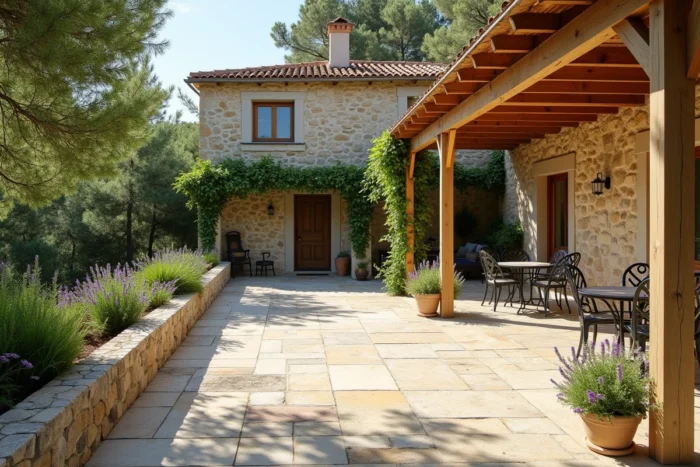
Let’s take two concrete examples. Tiles laid directly on the ground on a bed of sand, without foundation or anchoring, constitute a removable ground-level terrace. It does not factor into the calculation of property tax. In contrast, a raised terrace on stilts, poured on a concrete slab, or permanently fixed to the structure of the house, is considered a built dependency.
This second case alters the cadastral rental value of your property. The administration treats it as a secondary element, just like a garage or a conservatory. Knowing how to declare a terrace for tax purposes precisely avoids this type of unpleasant surprise when receiving the property tax notice.
Tax declaration on the Manage My Real Estate portal
Since 2023, the tax administration directs property owners to the Manage My Real Estate (GMBI) portal on impots.gouv.fr to report works that modify the nature of a property. This platform effectively replaces most of the old paper declarations.
Concrete steps on GMBI
The procedure takes place entirely online. A dedicated notice published by the administration details the process:
- Log in to your personal space on impots.gouv.fr and access the “Manage My Real Estate” section.
- Select the property in question, then indicate the nature of the work carried out (construction of a raised terrace, covered extension, addition of a dependency).
- Provide the created area and the date of completion of the work, two pieces of information that the tax service uses to recalculate the cadastral rental value.
- Validate the declaration. A digital acknowledgment of receipt confirms its consideration.
The property declaration must be submitted within 90 days of the completion of the work. This deadline applies whether or not the terrace requires prior planning permission.
Development tax: a separate aspect
If your work creates an enclosed and covered area with a ceiling height exceeding 1.80 meters, a declaration of urban planning taxes is also required via GMBI. An open terrace (not covered) does not fall under this category. However, a terrace covered by a fixed roof may be subject to it.
Planning permission before the tax declaration
The tax process is only part of the procedure. Even before construction, it is necessary to check if planning permission is required. The two obligations are independent but complement each other.
An uncovered ground-level terrace does not require any permission, unless your land is located in a protected area (near a historical monument, classified site). In this case, a prior declaration of works is required.
For a raised terrace, the thresholds depend on the area:
- Up to 20 m² of ground area: a prior declaration of works is sufficient (Cerfa form available online or at the town hall).
- Beyond 20 m²: a building permit becomes mandatory.
More and more municipalities offer online submission via a Digital Counter for Urban Planning Authorizations (GNAU), accessible at all times. Paper submission at the town hall remains possible but is becoming less common.
Actual impact on property tax and housing tax
You have declared your terrace. What concrete effect does it have on your local taxes? Once registered as a built dependency, the terrace increases the cadastral rental value of your property. This value serves as the basis for calculating property tax.
For secondary residences, the terrace can also increase the housing tax, since it has only been abolished for primary residences. The coefficient applied varies according to the municipality and the nature of the development.
A point often overlooked: new constructions may benefit in some cases from a temporary exemption from property tax for two years. However, this exemption only applies if the declaration has been made within the 90-day deadline. Exceeding this deadline means losing the benefit of the exemption and risking an adjustment.
Consult the PLU before any terrace project
The local urban planning plan of your municipality may impose constraints that neither the national urban planning code nor the tax portal mentions. Distances from property boundaries, authorized materials, maximum height: these rules vary from one municipality to another.
If the PLU does not specify anything particular, default distances apply: construction at the property line or at least three meters away. For views over neighboring properties, the minimum distance is 1.90 meters for direct views and 0.60 meters for oblique views, unless there is written agreement from the neighbor.
Contact the urban planning department of your town hall before starting work. This verification takes a few minutes and avoids a neighborhood dispute or forced compliance afterward. The tax declaration will follow once the terrace is completed and compliant with local rules.