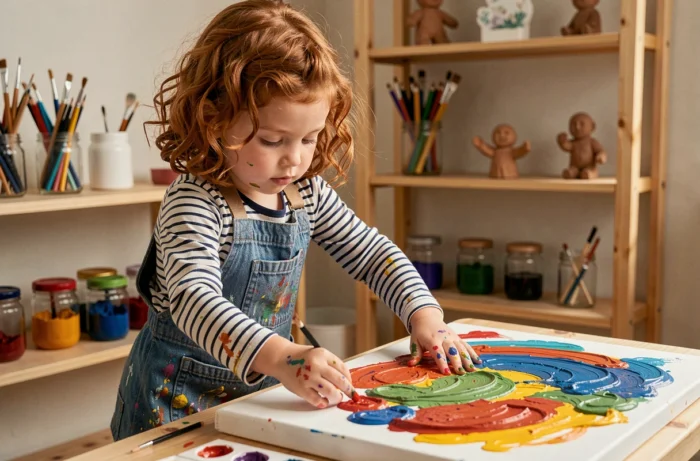
The French market for games and toys reached 4.7 billion euros in 2025, with a growth of 7.1% in value according to data from the Circana panel. Among the most dynamic segments, creative hobbies and DIY kits showed an increase of about +45% in the recent period, contributing to nearly 70% of the sector’s gains. This rise reflects a clear parental demand for toys that stimulate imagination rather than passive consumption.
Open toys and free play: what non-prescriptive materials really change
An “open” toy imposes no rules or expected outcomes. A block of wood, a modular construction game, a sensory bin filled with natural materials: the child decides how to use it. This lack of predefined instructions is the main lever of free play, an approach where the child appropriates the object at their own pace.
Field reports vary on the time needed before a child accustomed to single-function toys spontaneously engages with open materials. Some educators observe a hesitation phase of a few days, while others note immediate appropriation. The common point remains that non-prescriptive toys generate longer play sequences once adopted.
Among the frequently cited references in this category are Janod’s wooden ranges, large-format building blocks, and suction cup assembly games like Squigz. On Kidits, families can compare several brands positioned in this niche of creative wooden toys and sustainable materials.
Sensory DIY kits: why this segment is booming
Boxes to make your own squishies, slimes, candles, or soaps: sensory DIY kits are capturing an increasing share of the market. Their success is based on a simple mechanism. The child follows a protocol (measuring, mixing, molding), then personalizes the final result (colors, shapes, textures).
This dual movement, guided execution followed by creative freedom, meets a need that is often underestimated. Not all children are comfortable in front of a blank sheet. The kit provides a reassuring framework that allows entry into the activity without the pressure of “creating from scratch.”
- Creative hobby kits based on sensory materials (dough, sand, ironing beads) are suitable from 3-4 years with supervision, and independently around 6 years
- Scientific kits combining experimentation and creation (making crystals, invisible inks) target 7-10 year-olds and add a layer of causal understanding
- Sewing, jewelry, or mosaic kits develop fine motor skills and planning, with portable or giftable results, enhancing the child’s pride
The known limitation of these kits: once the contents are used, the object cannot be replayed. In contrast, an open construction game reinvents itself with each session. Combining a one-time DIY kit with a durable open toy allows for varied creative stimuli without accumulating disposable materials.
Musical and bodily creativity: often neglected toys
Articles on children’s creativity heavily focus on manual and visual activities. Musical instruments suitable for children and games involving the body are rarely addressed, even though they engage different creative registers.
A percussion kit (tambourine, maracas, claves) allows a child from 2 years old to explore rhythm, volume, and alternation. There is no “right answer”: it is open play applied to sound. For older children, simple melodic instruments (xylophone, kalimba) introduce the notion of sequence and composition without going through music theory.
Dress-up works on the same principle of free exploration. A chest with a few accessories (hats, capes, masks) is enough to trigger scenarios of symbolic play. The child constructs a character, a story, a universe, three creative skills that are not engaged by coloring or modeling clay.
Choosing a creative toy by age: concrete criteria
The mention “from X years” on the packaging concerns safety (small parts, CE standards), not creative potential. A 4-year-old may get bored with a toy labeled 3-6 years if they have already developed certain motor skills. The opposite is also true.
- Before 3 years: prioritize sensory awakening toys with varied textures, stackable wooden toys, water games. Free manipulation takes precedence over the outcome
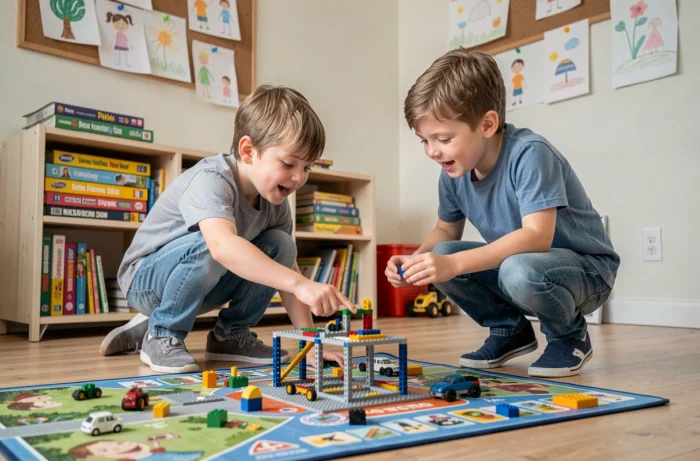
- From 3 to 6 years: construction games (blocks, magnetic, assembly boards), modeling clay, first painting kits. The child begins to have a project (“I’m making a house”) even if it changes along the way
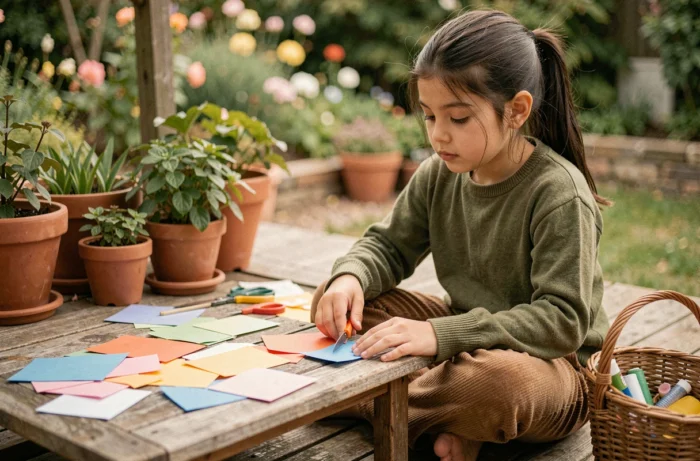
- From 6 to 10 years: more elaborate DIY kits, creative logic games, instruments, picture theater like Kamishibaï. The child can plan, execute, and evaluate their own work
A rarely mentioned criterion: replayability. An effective creative toy is one that the child uses differently at 4 years and at 7 years. Wooden construction games and exploration bins meet this criterion better than most single-function toys.
Price is not always correlated with creative value. A set of raw wooden blocks often costs less than a limited-use electronic toy and generates hours of incomparably more varied play. The most cost-effective investment remains a durable, modular, battery-free toy that the child can repurpose from its initial function.