
Selling a motorcycle between private individuals in France requires producing a precise administrative document: the certificate of transfer. This official form, Cerfa n°15776, triggers the transfer of ownership and protects the seller against any infractions committed after the transaction. The version in effect in 2026 is the Cerfa n°15776*03, which replaces earlier versions still available on some third-party sites.
Checking the complete number printed at the top right of the document before downloading it prevents filling out an outdated form.
Cerfa 15776*03 and France Titres: what changes concretely in 2026
Most online guides still refer to the historical ANTS portal to declare the transfer of a vehicle. In 2026, the administrative process will go through France Titres as the online declaration portal. The Cerfa 15776*03 form can be downloaded from formulaires.service-public.gouv.fr, filled out in two copies (one for each party), and then the transfer declaration is registered online on France Titres within fifteen days after the sale.
This change in interface does not alter the substance of the procedure, but it shifts the digital entry point. A seller attempting to use the old ANTS portal may be redirected or encounter errors. In practice, it’s better to go directly to France Titres to avoid unnecessary back-and-forth.
To fully understand the steps for the motorcycle transfer certificate, it is essential to distinguish between two phases: preparing the file before meeting the buyer, and then the online declaration that formalizes the transfer of ownership.
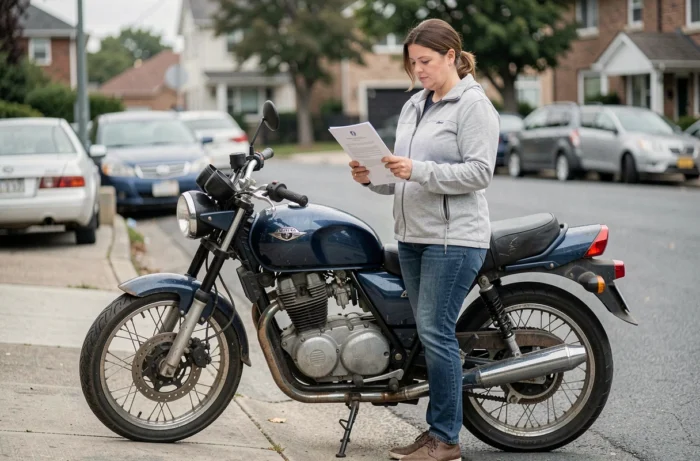
Documents to gather before selling a used motorcycle
The transfer certificate does not work alone. It is part of a set of documents that, when combined, secure the transaction for both parties. Omitting any one of them can block the registration on the buyer’s side or leave the seller legally exposed.
- The registration certificate (carte grise) of the motorcycle, on which the seller must write clearly and indelibly the mention “sold on” or “transferred on” followed by the date, time, and their signature, before handing it over to the buyer.
- The administrative situation certificate, also known as the non-pledge certificate, which can be downloaded for free via the Histovec site. This document certifies that the motorcycle is neither pledged nor subject to an opposition to the transfer of ownership. Its validity is time-limited: it must be dated less than fifteen days before the sale.
- The technical inspection, when required. For motorcycles, the obligation for technical inspection is more recent than for cars, and the conditions of application depend on the engine size and the date of first registration. Checking its precise status before putting it up for sale avoids last-minute blocks.
- The maintenance log and repair invoices are not mandatory, but they reassure the buyer and can justify the asking price.
Transfer code: a short deadline that traps sellers and buyers
At the end of the online declaration on France Titres, the seller receives a transfer code. This code is transmitted to the buyer so they can initiate their own registration request online. The sensitive point: this transfer code has a limited validity period.
If the buyer delays in initiating their registration request, the code expires. The seller must then restart the procedure to generate a new one, which requires the availability of both parties and access to the portal. In practice, field feedback shows that this deadline is a frequent source of blockage, especially when the sale occurs on a weekend or during a holiday period.
The solution is simple: transmit the transfer code on the same day as the transaction and ensure that the buyer has all the elements to make their request quickly. An exchange via SMS or email right after the sale leaves a useful written record in case of dispute.
Special case: lost or stolen registration certificate
If the seller cannot provide the original registration certificate because it has been lost or stolen, the procedure becomes more complicated. A declaration of loss or theft must be made before the transfer. The seller then obtains a duplicate or a temporary document that allows the sale to be finalized. Without this prior step, the buyer will not be able to register the motorcycle in their name.
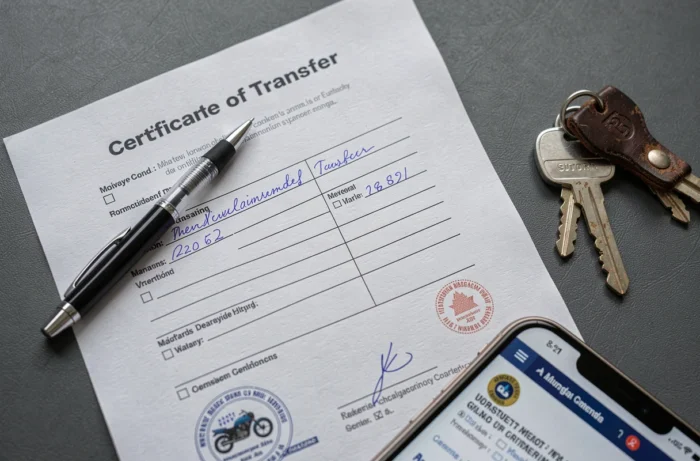
Co-owners on the motorcycle registration certificate: a often overlooked formality
When the registration certificate mentions several owners (a couple, for example), all co-owners must sign the transfer certificate. The absence of one signature renders the document incomplete and may lead to the rejection of the buyer’s registration request.
This situation is more common than one might think for motorcycles purchased as a couple or financed jointly. Before scheduling a meeting with the buyer, checking section C.4.1 of the registration certificate allows one to see if a co-owner is listed. If so, the presence or written proxy of the co-owner is essential on the day of the sale.
Motorcycle transfer declaration: the fifteen-day deadline and its consequences
The seller has fifteen days after the transfer to declare the sale online. This deadline is not indicative: after this term, the seller remains legally responsible for the vehicle. Any infraction committed with the motorcycle (speeding, parking) will be attributed to them as long as the declaration is not recorded.
The buyer, for their part, has one month to request registration in their name. Riding without an updated registration certificate beyond this deadline exposes them to a fine. The two timelines are independent: the seller does not have to wait for the buyer to complete their registration to make their own declaration.
Keeping a copy of the signed transfer certificate, a copy of the crossed-out registration certificate, and the confirmation of the online declaration constitutes a solid proof file. In case of a ticket received after the sale, these documents allow contesting the fine with the competent public prosecutor.