Sublimating an interior doesn’t necessarily require major renovations or a significant budget. Decoration relies on a few specific levers (color, light, materials, proportions) whose mastery produces visible results, even on a small scale. The choice of a coherent palette, the treatment of wall surfaces, or the arrangement of furniture transforms the perception of a space without altering its structure.
Monochromatic Palette: The Color Trend Redefining Volumes
Strong contrasts between walls and ceilings are losing ground. The interior decoration palettes for 2026 favor subtle variations of the same color applied to walls, ceilings, and woodwork. The goal: to create an enveloping space rather than an isolated accent wall.
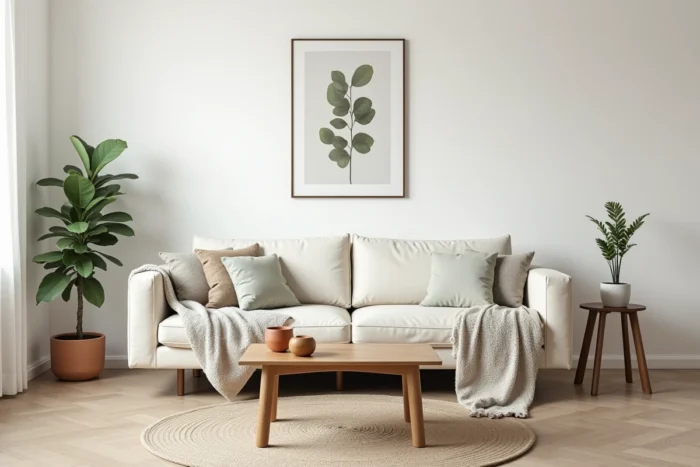
In practical terms, this means choosing a base shade, then varying two or three close hues across the different surfaces of the room. A living room painted in three shades of sage green, from the lightest on the ceiling to the darkest on the woodwork, gains depth without visually shrinking.
The shades dominating this year are soft, warm, and slightly pigmented. Dusty rose, blending pink and beige, or shades inspired by the 70s are making a strong comeback. These colors soothe rooms while giving them a strong identity, far from the off-white default that has long served as a safe choice.
On the homepage of Point Contre Point, various approaches to interior design are discussed to go beyond generic recipes.
Natural Materials and Textures: Creating a Sensory Interior
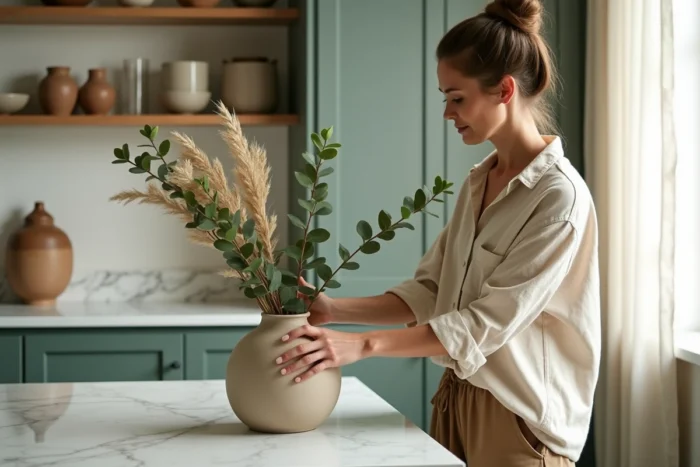
The current trend leans towards more sensory and immersive spaces. The interplay of textures, soft shapes, and authentic materials takes precedence over sophisticated imitations. Bamboo, natural fibers, eco-friendly coatings: touch becomes a criterion for choice on par with visual appeal.
This sensory shift changes the way we think about layout. A raw linen sofa placed on a jute rug, facing a lime-washed wall, creates a tactile richness that no entirely smooth interior can match. The layering of textures compensates for the sobriety of the aforementioned monochromatic palettes.
Which Materials to Favor Room by Room
- In the living room, pair upholstery fabric made from natural fibers (linen, washed cotton) with elements in raw wood or rattan to anchor a warm atmosphere without overwhelming.
- In the kitchen, natural stone or waxed concrete countertops provide a lively texture that ages well, as long as one accepts a gradual patina.
- In the bedroom, opt for layered textiles (cotton gauze bedspread, corduroy cushions) rather than a single coordinated set, for a less rigid look.
A textured interior absorbs light and sound better, enhancing acoustic and visual comfort without heavy technical intervention.
Natural and Artificial Light: Lighting as a Tool for Interior Decoration
Light determines the perception of colors and volumes. A room with carefully chosen hues will appear dull under poorly considered lighting. Multiplying light sources at different heights (wall sconces, table lamps, pendants) allows for modulation of the ambiance according to the time of day.
The classic trap is to concentrate lighting on the ceiling. A single ceiling fixture casts harsh shadows and flattens reliefs. Three light points distributed throughout the room, at different intensities, are enough to create a depth that furniture alone cannot produce.
Color Temperature and Rendering of Wall Shades
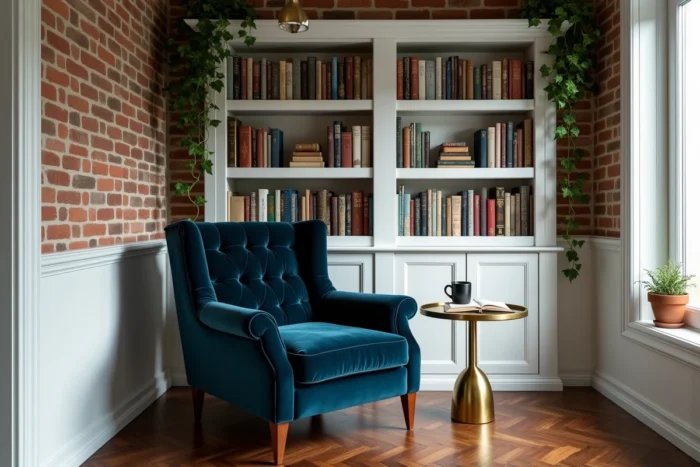
Light bulbs with a warm color temperature (around 2,700 K) remain the standard for living spaces. With the current monochromatic palettes, overly cool lighting pulls hues towards gray and negates the enveloping effect sought.
For workspaces or the kitchen, a slightly more neutral temperature is better, but without exceeding neutral white. The idea is to avoid creating a harsh break between two adjacent rooms.
Furniture Arrangement: Proportions and Flow in Space
Before choosing a piece of furniture, the first factor to consider is the circulation space. A clear passage of at least 60 centimeters between furniture ensures fluid movement, making the room more pleasant to live in, even in a small area.
Placing the sofa first in a living room and then organizing the rest around it prevents ending up with a cluttered space where each addition feels excessive. The sofa defines the main axis, oriented towards the light source or a focal point (fireplace, bay window, textured wall).
- In a rectangular living room, positioning the sofa perpendicular to the longest wall breaks the hallway effect and creates two distinct zones.
- In an open space, a rug under the seating area visually delineates the space without partitioning.
- For small areas, multifunctional furniture (storage bench, extendable table) frees up floor space, amplifying the feeling of space.
The choice of proportions is as important as the style. A piece of furniture that is too large for the room overwhelms everything else, regardless of its design. Measuring the available space before purchasing remains the most cost-effective reflex in decoration.
A successful interior rarely relies on a single spectacular gesture. It is the accumulation of coherent choices (unified palette, varied textures, appropriate lighting, proportionate furniture) that produces a result where one feels good. The final adjustment to make is often the simplest: removing one object rather than adding a new one.