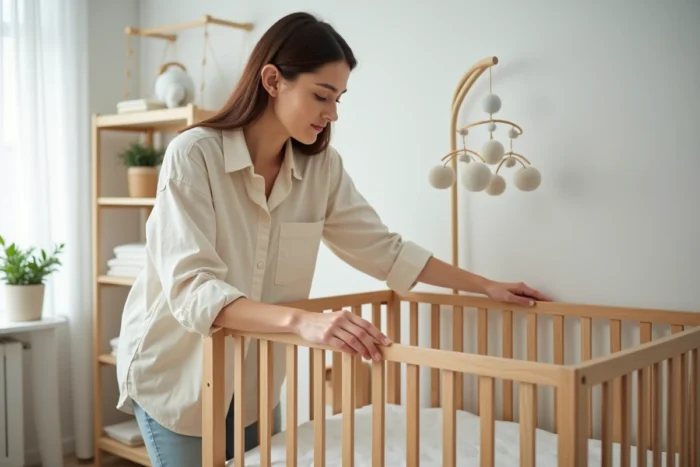
A three-month-old baby sleeps in a crib that fits him perfectly. Six months later, his feet touch the edge, and we find ourselves urgently looking for a bed. This scenario is encountered with every first child.
The choice of baby bed size is not made on a whim in the store, but rather on concrete anticipation: the size of the room, the intended duration of use, and safety constraints related to the height of the mattress.
Mattress height and usable depth: the criterion that size alone does not address
Baby beds are often compared by their length and width. The real technical issue lies elsewhere: the relationship between the height of the bed base and the thickness of the mattress determines the usable depth of the bed, meaning the distance between the top of the mattress and the top of the bars.
A child growing in a 70×140 cm bed often uses it beyond two years. At this age, he stands up and tries to climb. If the bed base is set too high or if the mattress is thick, the usable depth decreases and the risk of falling increases. This combination of “bed base height + mattress thickness + child’s size” is just as important as the floor dimensions.
To precisely compare the available formats and their respective limits, a detailed summary can be found on baby beds on Maman du Net, which classifies each type by age group and usage.
In practice, when buying a crib, we check that the bed base offers at least two adjustable positions. The low position becomes mandatory as soon as the child can sit up alone. For a 70×140 cm convertible bed, this check is even more critical since the bed is used for a longer time.
Baby bed 60×120 cm or 70×140 cm: deciding based on space and duration
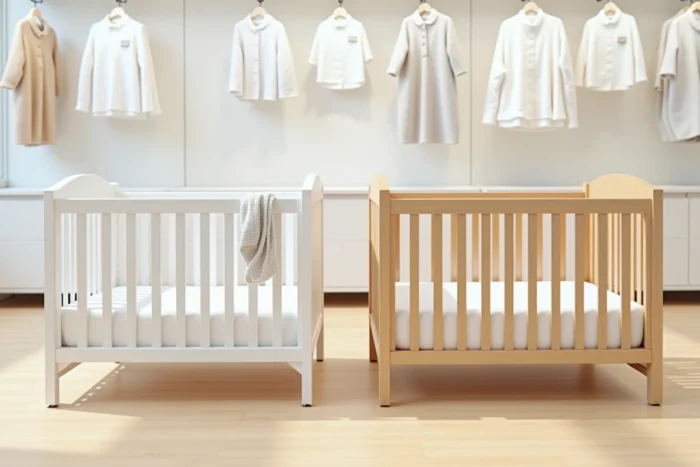
The 60×120 cm format remains the standard for small rooms. It takes up less space, is generally cheaper, and fitted sheets and mattresses are widely available. Its main limitation: it becomes too small around two years, sometimes earlier if the child is tall for his age.
The 70×140 cm format offers a sleeping arrangement that can be used longer, often until four or five years. It buys time before transitioning to a child bed. In return, it occupies more floor space, and bedding can sometimes be harder to find in large stores.
Points to decide before purchase
- Measure the actual space in the room, accounting for door openings, the location of the changing table, and the minimum passage for circulation. A 70×140 cm bed in a room smaller than 8 m² can block all movement.
- Estimate the desired duration of use: if a second child is planned soon, the freed 60×120 cm bed will serve the younger one while the older one moves to a larger bed.
- Check mattress compatibility: the thickness of the baby mattress must not reduce the usable depth below the safety threshold, regardless of the chosen format.
Feedback varies on this point, but several parents find that the 60×120 cm is more than sufficient for a first child in an urban apartment, even if it means investing in a child bed around two and a half years.
Montessori floor bed: an alternative that changes the size question
In recent years, floor cabin beds and Montessori beds have made their way into French buying guides. The principle: place a mattress directly on the floor or on a very low frame, without bars. The child can enter and exit their bed independently, promoting autonomy.
This format changes the choice logic. The size of the mattress is no longer constrained by a bar frame, and one can opt for a 70×140 cm or even an 80×160 cm, without worrying about the height of the fall since there is virtually none.
Concrete advantages and limitations of the floor bed
The main advantage is the freedom of movement. An 18-month-old child who wakes up at night can lie back down alone without calling. The transition from the crib is stress-free regarding the removed bars.
The limitation is clear: before the child can roll and crawl safely, the floor bed is not suitable. A newborn a few weeks old needs a contained space. One only moves to a Montessori bed when the child can move independently, generally around eight to ten months depending on the child.
The other constraint concerns the room itself. A mattress on the floor in a poorly insulated or humid room poses a hygiene problem. Regular airing of the mattress and a constantly clean floor must be planned.
Cradle, bassinet, and travel cot: temporary formats and their actual lifespan
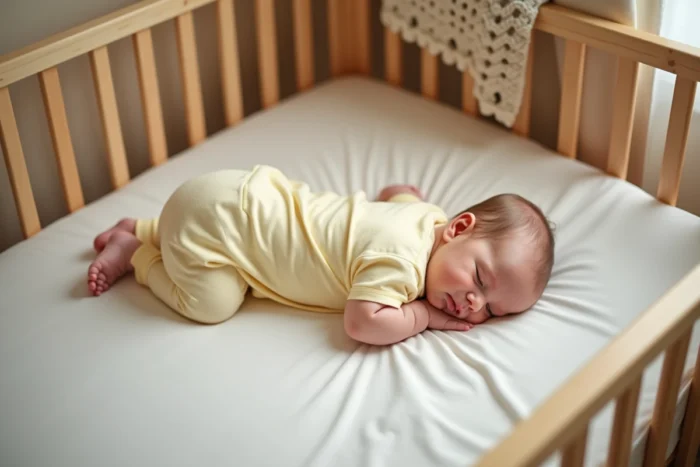
The bassinet (standard dimensions around 40×80 cm) and the cradle (about 40×90 cm or 45×90 cm) are solutions for the very beginning of life. Their advantage: the cocoon effect reassures the newborn and facilitates falling asleep during the first weeks.
Their disadvantage is their very short duration of use. A bassinet is only used for a few months, sometimes less than four. The cradle lasts a little longer, but one moves to a crib as soon as the child starts to roll over and move actively.
The travel cot, often used at grandparents’ houses or while traveling, is not designed as a primary sleeping arrangement. Its thin mattress and soft structure make it practical for occasional use, not for prolonged daily use. If the travel cot becomes the everyday bed, sleep quality suffers.
- Bassinet: a few weeks to three months, ideal for the very first days.
- Cradle: up to about five or six months, provided the child is not yet standing.
- Travel cot: supplementary only, not a primary sleeping arrangement.
- Crib 60×120 cm: from birth to about two years.
- Crib or convertible bed 70×140 cm: from birth to four or five years.
The choice of the ideal baby bed size is based on three concrete data: the available space in the room, the age until which one wants to use the same bed, and the usable depth that ensures safety as the child grows. Measuring before buying, checking the bed base adjustment, and anticipating the next step prevent hasty replacements.