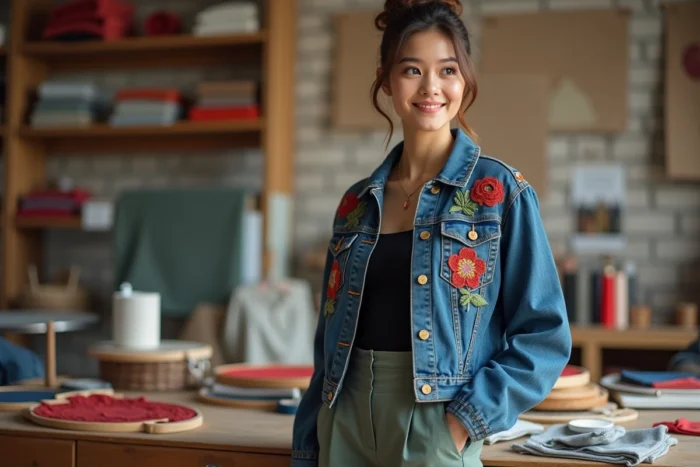
A personalized garment is not just a name printed on a t-shirt. Textile personalization refers to any graphic or technical intervention (embroidery, printing, transfer, patch) that transforms a standard piece into a medium of expression. In 2026, demand is shifting towards pieces called “storytelling,” where the visual worn tells a story rather than simply displaying a logo.
Narrative wardrobe: personalize a garment to tell a story
The concept of a narrative wardrobe is based on a simple principle: each personalized piece corresponds to a chapter of your journey. A sweatshirt embroidered with a GPS coordinate can mark a birthplace or a foundational trip. A tote bag printed with a sketch recalls a completed creative project.
This approach contrasts with decorative personalization, where the choice is limited to a color, a font, and a name. Building a coherent visual narrative requires defining in advance the themes you want to carry, in the literal sense: values, significant memories, personal goals.
In practical terms, this means treating your wardrobe like an editorial collection. Each addition must serve a purpose. A connected accessory with an NFC chip can even link to digital content (video, portfolio, personal page), creating a bridge between the textile and your online identity. Specialized platforms offer this type of advanced personalization, as seen on https://www.always-unique.net/, which brings together accessories and clothing designed to reflect a unique identity.

Textile personalization techniques: embroidery, printing, and transfer
Before choosing a design, it’s essential to understand what each technique allows and imposes. The finish, durability, and cost vary significantly depending on the method.
Embroidery on cotton or polyester fabric
Embroidery remains the most durable marking method on a personalized garment. The thread is anchored in the fabric, which withstands repeated washes. It is suitable for small visuals (logo, initials, symbol) on sufficiently dense materials: thick cotton, fleece, bag canvas.
The main limitation is the complexity of gradients. A photographic or highly detailed design is not suitable for embroidery. However, for a monogram or a pictogram that encapsulates a memory, it provides a tactile relief that no printing can replicate.
Direct printing and transfer
Direct-to-garment (DTG) printing allows for the reproduction of complex visuals in unlimited colors on light cotton. It is the technique suited for narrative t-shirts with detailed illustrations.
Transfer (screen printing or vinyl) offers a better cost-effectiveness for series. Vinyl adheres well to synthetic textiles where DTG ink adheres less effectively. For a cap or a polyester bag, transfer often remains the most relevant choice.
- Embroidery: maximum durability, ideal for logos and symbols on dense cotton or fleece
- DTG printing: unlimited colors, detailed visuals, best on light cotton
- Vinyl transfer: suitable for synthetic textiles and small accessory series
- Iron-on embroidered patch: removable, repositionable, allows for evolving personalization without altering the garment
Personalized accessories: beyond the t-shirt
The personalized t-shirt captures most of the attention, but accessories often offer longer visibility. A cap or a bag is worn daily for months, sometimes years, whereas a shirt may be relegated to the back of the closet.
Custom embroidered patches deserve special attention. Iron-on or sewn, they transform any jacket or bag into a modular narrative medium. You can add a patch after a trip, an event, or a professional milestone without having to buy new clothing.

Connected accessories represent a recent evolution. Water bottles or textiles incorporating an NFC chip or QR code link to a digital experience: personal website, video, member area. This type of personalization creates an additional layer of storytelling, invisible to the eye but accessible with a gesture.
Choice of fabric and quality of personalization: technical criteria
The quality of the result depends as much on the base textile as on the marking technique. An impeccable visual on a mediocre fabric will distort after the first wash.
Cotton remains the reference textile for personalization. Its fiber absorbs DTG ink well, accepts embroidery without excessive distortion, and offers recognized comfort. For garments worn outdoors (jackets, caps), a cotton-polyester blend provides durability without sacrificing print quality.
Weight also matters. A t-shirt that is too thin will pucker under embroidery and show through the ink layers. Opt for a sufficiently dense weight so that the fabric remains stable after marking. Reputable suppliers consistently indicate this information.
- Check the fabric composition before choosing the technique (cotton for DTG, polyester for vinyl transfer)
- A weight that is too low compromises the durability of the marking after repeated washes
- Textile certifications (OEKO-TEX label, for example) guarantee the absence of harmful substances in contact with the skin
Fabric color and visual rendering
On dark fabric, DTG printing requires a white underlayer that thickens the finish. If your visual narrative relies on subtle shades, start with a light fabric. On black or navy, embroidery or vinyl transfer will yield a sharper result.
The choice of fabric determines the technique, not the other way around. Starting with the garment to determine the marking process avoids disappointment.
Building a personalized wardrobe that carries meaning ultimately requires few pieces, but precise choices regarding fabric, technique, and design. A well-thought-out accessory, with a visual that refers to a real moment in your journey, has more impact than a dozen hastily printed t-shirts. The most successful personalized garment is the one you still wear in three years because it still tells something true.