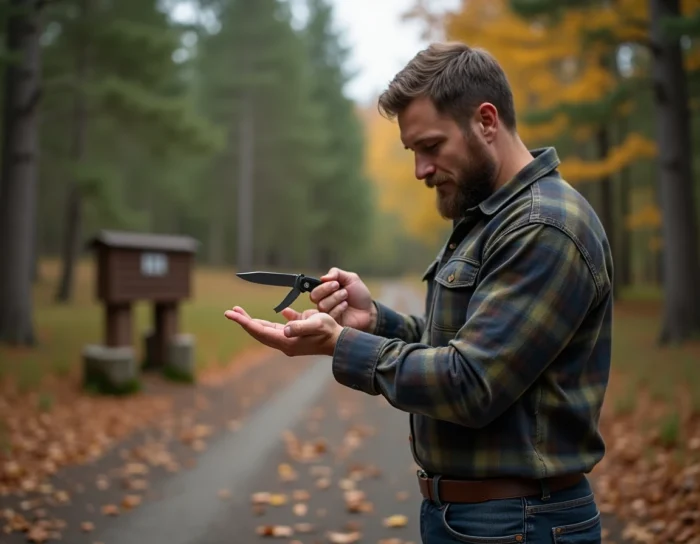
In Quebec, carrying a pocket knife is not subject to specific provincial regulations. The applicable framework is that of Canadian federal criminal law, which applies uniformly across the country. This peculiarity creates a gray area that many residents and travelers struggle to interpret: the same knife may be perfectly legal in one context and trigger a seizure, or even prosecution, in another.
Understanding the legislation on pocket knives in Quebec requires focusing less on the object itself and more on its opening mechanism, the intent of its bearer, and the context in which it is carried.
Pocket Knife in Canada: The Opening Mechanism Determines Legality
The fundamental distinction in Canadian law does not rest on the size of the blade or the commercial name of the knife. It concerns the design and mechanism. The Canada Border Services Agency (CBSA) classifies a knife as a prohibited weapon when it is designed to open automatically by pressing a button, by gravity, or by centrifugal force.
A switchblade, a butterfly knife (balisong), or a gravity knife fall into this category. Their possession, sale, and importation are prohibited throughout Canada, including Quebec.
In contrast, a traditional folding knife that requires a manual action with both hands (or one hand with mechanical resistance) to deploy the blade remains an ordinary object in the eyes of the law. Knives like Opinel, traditional pocket knives, and most Swiss Army knives fall into this category.

The ambiguity arises with knives referred to as “assisted opening.” These models require an initial manual push, after which a spring completes the deployment. The line between assisted opening and automatic opening remains subject to interpretation by CBSA agents and law enforcement. In practice, a border agent who observes that a knife opens too easily with one hand may consider it prohibited and seize it.
Carrying a Knife in Quebec: Intent Matters as Much as the Object
Owning a legal pocket knife at home poses no legal issues. Carrying it in a bag during an outdoor activity (camping, fishing, hiking) is also permissible, provided the use is consistent with the context.
The Canadian Criminal Code prohibits carrying a concealed weapon on one’s person. A pocket knife, even legal by its mechanism, can become a weapon in the criminal sense once the intent to use it against a person is established or presumed. A police officer who stops someone carrying a folding knife in a downtown Montreal bar will not interpret the situation the same way as if they encounter a camper on a trail in Gaspésie.
This framework based on intent rather than the object creates a broad area of discretion for law enforcement. Field reports vary on this point: some pocket knife carriers report never having been questioned, while others have had a simple pocket knife confiscated during a routine urban check.
Evaluation Criteria Used by Police Officers
- The type of knife and its opening mechanism, which determines whether it is prohibited by federal law
- The location and time of the check: a bar, a sporting event, or a demonstration increases the level of suspicion
- The explanation provided by the bearer regarding the reason for having the knife, and its consistency with the context
- The manner in which the knife is carried (in a bag, in a pocket, visibly on a belt)
Importing and Buying Knives Online: The Trap of the Canadian Border
Buying a knife from a foreign website and having it delivered to Quebec exposes one to the risk of seizure at customs. The CBSA inspects packages and can confiscate any knife that fits the definition of a prohibited weapon. The recipient is generally not notified before the seizure and does not recover the item.
The issue also arises for travelers bringing back a knife purchased abroad. A model sold freely in another country may fall under the Canadian prohibition. Butterfly knives, for example, are freely sold in several U.S. states but are strictly prohibited in Canada.
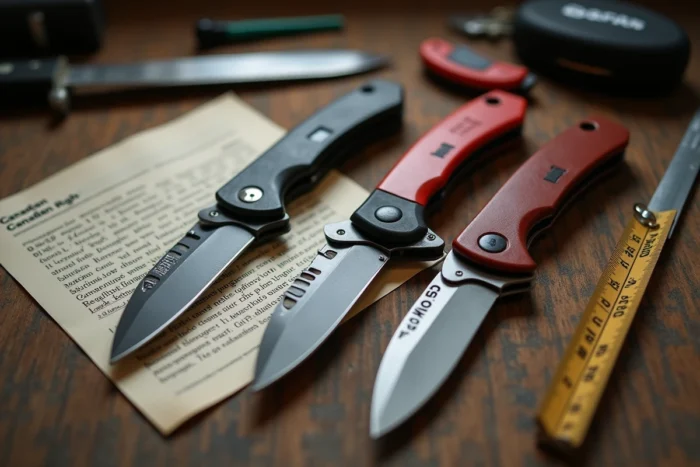
The absence of a comprehensive list published by the CBSA complicates matters. The available data do not allow for a definitive conclusion for each specific model: the decision of the border agent relies on a physical examination of the knife and their interpretation of the opening mechanism. The same model may pass the border once and be seized the next time.
Criminal Penalties for Illegal Carrying of a Knife in Quebec
Carrying a prohibited knife or using a legal knife in a threatening manner exposes one to criminal charges. The Criminal Code provides for charges ranging from possession of a prohibited weapon to armed assault, depending on the circumstances.
A conviction for possession of a prohibited weapon can lead to imprisonment. For a non-prohibited knife carried in a context deemed dangerous, the most common charge is possession of a weapon for a purpose dangerous to the public peace.
Key Points to Remember About the Consequences
- A customs seizure does not automatically lead to prosecution, but the item is not returned
- Carrying a prohibited knife constitutes a criminal offense, even without demonstrated aggressive intent
- A legal knife used in a threatening manner transforms the object into a weapon in the sense of the Criminal Code
- A criminal record for a weapons-related offense can have repercussions on travel and employment applications
The Quebec framework, because it relies entirely on Canadian federal law, leaves no room for provincial maneuvering. No municipality or province can relax federal rules on prohibited weapons. For anyone carrying a pocket knife in Quebec, the most effective precaution remains to stick to models with a classic manual opening and to be able to justify a utility use consistent with the context.