Logistics storage encompasses all the physical and software means mobilized to store, organize, and ship goods. Between a pallet rack in a proprietary warehouse and a cloud platform that manages flows in real-time, the differences in cost and complexity are considerable. Choosing the right combination requires understanding what each category of solution covers, and especially what it does not cover.
Mobile scanning and batch management: the criterion that classic comparisons underestimate
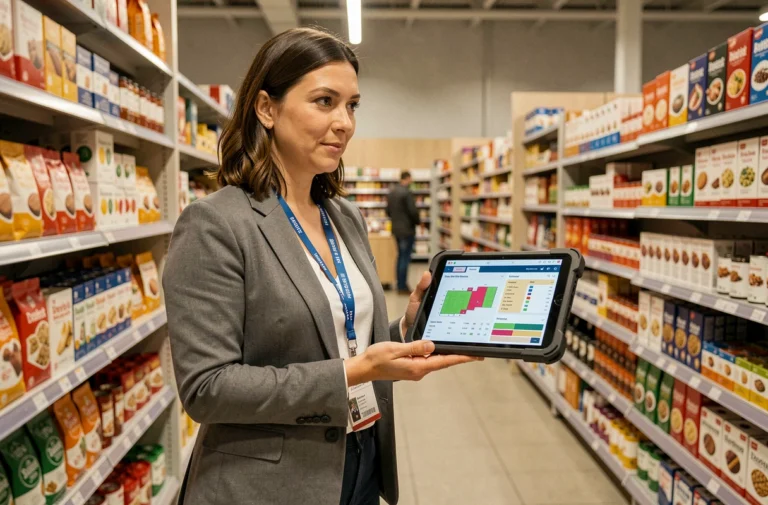
Most logistics software comparisons focus on general features (receiving, shipping, inventory). They often overlook a crucial point: the ability to operate in mobility with native scanning.
Field teams that receive or prepare orders in poorly networked warehouses need a tool that can be used offline, capable of scanning barcodes and managing batches with expiration dates (DLC). Solutions like GSE-Web or Monstock integrate these functions natively, whereas a generic ERP often requires an additional module or a dedicated terminal.
When comparing logistics storage solutions for businesses, this distinction between field tools and office tools radically changes the scope of the project. A food processing SME managing DLC has different constraints than a hardware wholesaler: the software suitable for one may be unusable for the other.

WMS, logistics ERP, and inventory management software: three distinct scopes
These three categories are often confused. They address different functional scopes, and mixing them leads to costly sizing errors.
The WMS manages the warehouse on a daily basis
A WMS (Warehouse Management System) manages the physical operations of a site: receiving, quality control, location assignment, order preparation, shipping, cycle counts. It offers complete traceability through connection with mobile terminals or RFID technologies.
This type of software is aimed at companies whose order volume or flow complexity justifies real-time management of each movement of goods. Reflex WMS, Easy WMS from Mecalux, or Akanea WMS Xtent are among the recognized solutions in the French market.
The logistics ERP covers the entire chain
A logistics ERP is not limited to the warehouse. It integrates supply management, flow planning (APS), transportation (TMS), and sometimes supplier relationships. Odoo or Sage offer logistics modules within their ERP, with the advantage of a unified view of the entire activity.
The trade-off is a more complex initial configuration, which often requires the intervention of an integrator as soon as the flows become multichannel. This nuance is rarely highlighted in rankings, which present these tools as “turnkey”.
Inventory management software remains targeted
For an organization that does not need to manage a complete warehouse, inventory management software (Erplain, Sortly, Zoho Inventory) is sufficient. These tools track stock levels, trigger replenishment alerts, and integrate with existing accounting. Their scope ends there.
- WMS: physical management of the warehouse, traceability by location, optimized order preparation. Suitable for high-volume flows or those with a strong traceability requirement.
- Logistics ERP: global view of the supply chain, including supply and transportation management. Requires a heavier configuration investment.
- Inventory management software: level tracking, alerts, accounting integration. Sufficient for SMEs with simple flows and a low number of references.
Physical storage: rack, self-storage, or outsourced logistics provider
The choice of software only addresses part of the problem. The physical storage infrastructure conditions performance just as much as the information system.
A proprietary warehouse equipped with heavy-duty pallet racks remains the most efficient solution for companies with stable and predictable volumes. Industrial shelving (solutions like Provost or equivalents) optimizes floor space by utilizing height, with configurations suited to the type of product (picking, bulk storage, long products).
For startups and growing SMEs, self-storage represents a lever of flexibility. It allows for renting modular spaces without long-term commitment, absorbing seasonal peaks without investing in a commercial lease. The cost per square meter is higher, but the absence of immobilization compensates over short durations.
Complete outsourcing to a logistics provider (like Geodis or regional players) transfers the management of warehousing, preparation, and shipping. This option suits companies for which logistics is not the core business and who prefer to convert fixed costs into variable costs.

Decision grid according to company profile
Rather than a generic ranking, the choice depends on three variables: order volume, product complexity (perishable, hazardous, fragile), and the desired level of control over the chain.
| Profile | Physical Infrastructure | Software Tool |
|---|---|---|
| SME, simple flows, fewer than 100 references | Self-storage or commercial space | Inventory management software (Erplain, Zoho Inventory) |
| Mid-sized company, multichannel flows, traceability required | Proprietary or shared warehouse | Dedicated WMS (Reflex, Easy WMS, Monstock) |
| Large group, international supply chain | Network of warehouses or outsourced provider | Logistics ERP with TMS/APS modules (SAP EWM, Odoo Enterprise) |
Proper sizing avoids paying for unused functions. An SME deploying a WMS designed for a large group will spend more time configuring this tool than preparing its packages. Conversely, a simple spreadsheet will not hold up against rapid order growth.
The segmentation between mobile field tools and structuring ERP platforms is increasing. Precisely identifying the weak link in one’s supply chain, whether physical or software, remains the first decision to make before any selection.