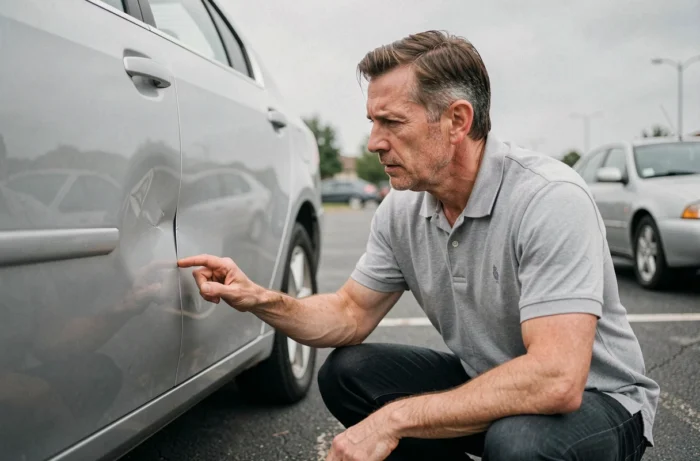
An impact on the bodywork, even at low speed, stresses much more than the visible sheet metal. Deformations propagate to the absorbers, the mounting supports, and sometimes to the chassis rails. Adopting the right reflexes after an impact on your car’s bodywork determines the quality of the repair, the amount of compensation, and the vehicle’s safety in the medium term.
Structural deformation after a bodywork impact: what the sheet metal doesn’t show
A bumper that visually returns to its original shape after an impact often hides a deformation of the foam or polystyrene shock absorber located behind the skin. This absorber is designed to compress only once. After an impact, it no longer fulfills its function of energy dissipation during a second collision.
We regularly observe cracked rear cross members under an apparently intact bumper in the workshop. The technical plastic (PA6-GF30) mounting supports break cleanly under stress, without visible deformation from the outside. A check with a lamp and by touch, by removing the bumper, remains the only reliable way to assess the situation.
Pressed steel wings transmit the energy of the impact to the wheel arches and the chassis anchor points. A dent on the front wing may indicate a shift of the engine cradle by a few millimeters, enough to distort the suspension geometry. If the door adjacent to the impact closes less well than before, the body has moved.
Before any administrative steps, it is useful to know how to act after a bodywork impact to correctly assess the severity of the damage and avoid underestimating the necessary intervention.
Mutual report and documentation of damages: costly mistakes
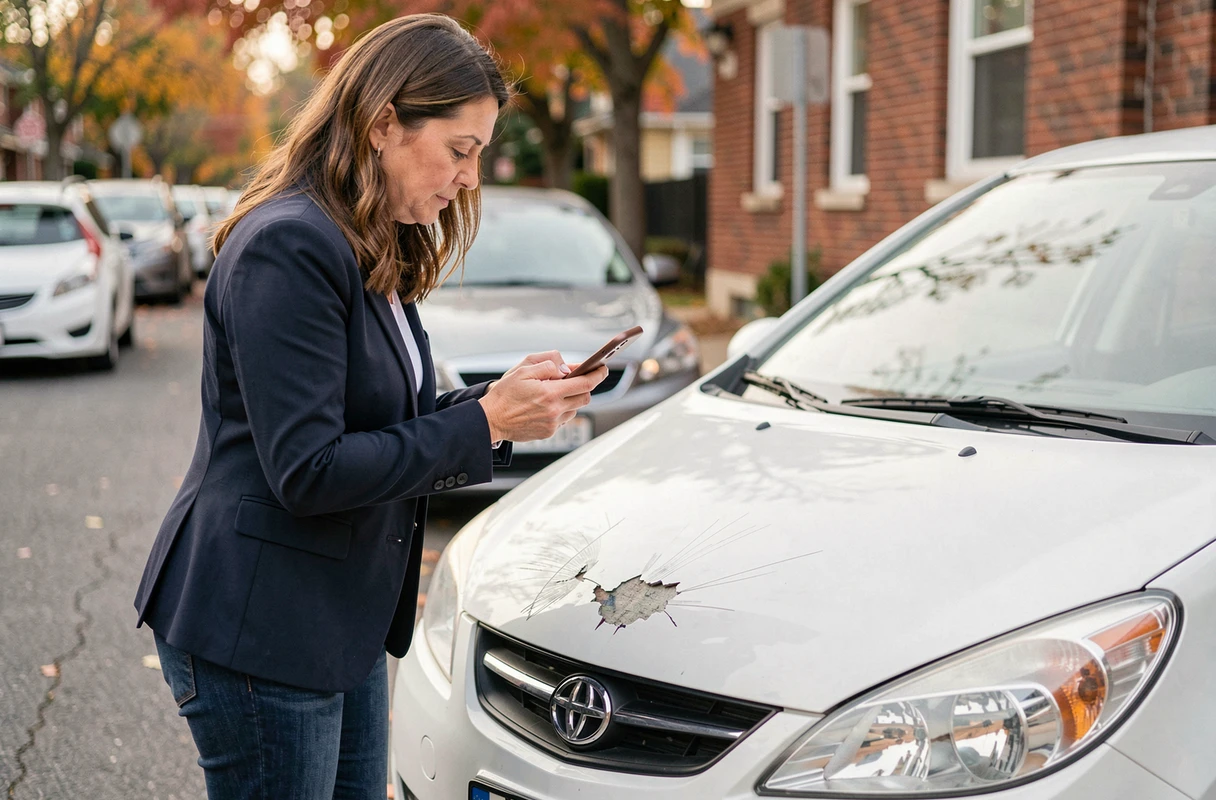
The European accident report must be filled out on-site, even in the absence of injuries and even if the damage seems minor. Some insurers refuse to process a claim that is properly documented afterwards, especially when the circumstances are disputed by the other party.
In case of disagreement about the sequence of the impact, calling the police resolves the issue. The report established by law enforcement facilitates the assignment of responsibilities by the insurer, whereas a crossed-out or contradictory report slows down the case.
Photographing the damages methodically
Photos taken at the scene of the impact are decisive evidence. We recommend systematically capturing:
- A wide shot showing the position of both vehicles, the ground markings, and the surrounding signage
- Close-ups of each damaged area, with a reference object (key, coin) to provide scale
- The license plates of the vehicles involved and, if possible, the faces of consenting witnesses
- Dashcam recordings, to be saved immediately on an external device to avoid automatic overwriting
Also keep receipts related to the claim (towing, rental vehicle). These documents are included in the calculation of the compensation.
Vehicle hit while parked
If you find your car damaged in a parking lot without a note from the responsible party, file a complaint for hit and run. Without a complaint, your insurer applies the full deductible and a 50/50 liability. Filing a complaint opens the possibility of later identification via the parking lot’s surveillance cameras.
Conversely, if you hit a parked vehicle and the owner is absent, wait a reasonable amount of time on-site before calling the police. Leaving without providing contact information constitutes a hit and run, which is subject to criminal penalties.
Auto claim declaration: deadlines and administrative traps
The claim declaration must reach your insurer within a five working day period following the impact. This period starts from the date of the accident, not from the date of discovering the damage (except in cases of vandalism or natural disaster, where the deadline differs).
Send the report by registered mail or via your insurer’s app if it timestamps the sending. A phone call is not sufficient as proof of timely declaration.
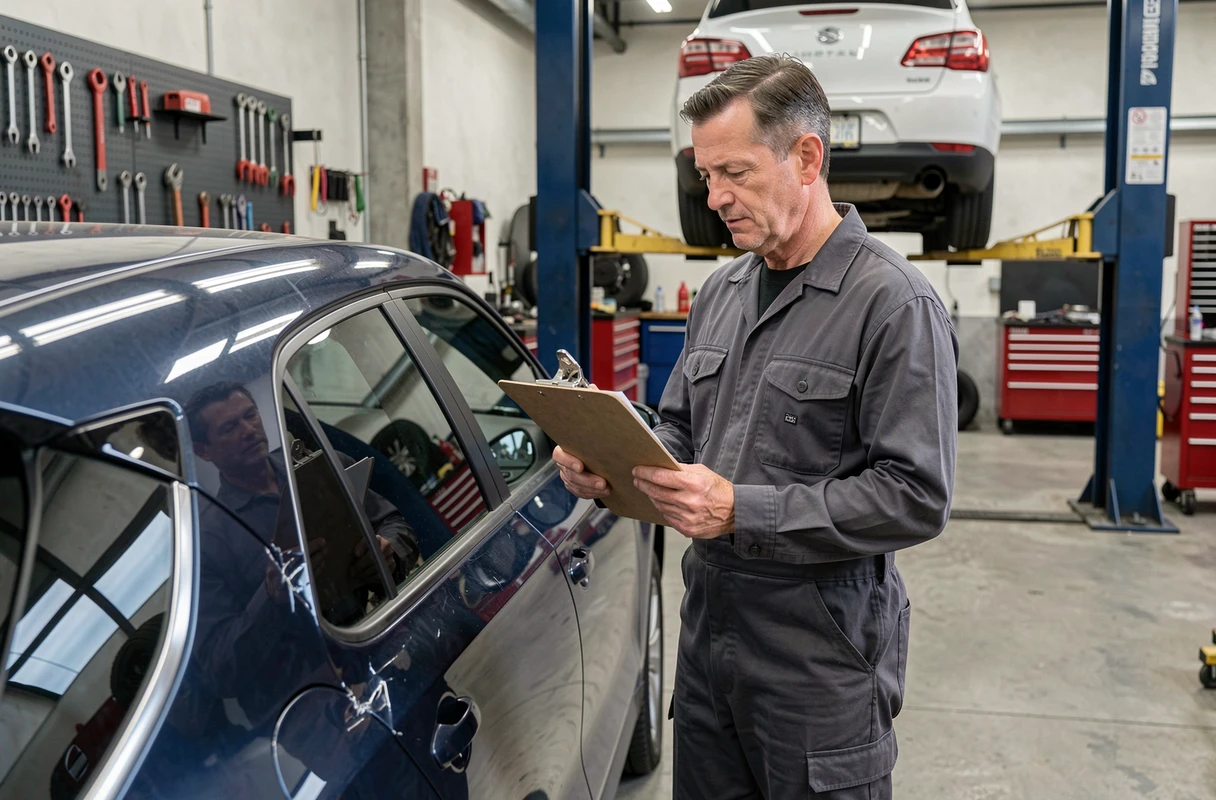
The insurer mandates an expert if the estimated repair costs exceed a certain threshold, which varies by contract. The expert assesses the damages and may propose a classification as a economically irreparable vehicle (VEI) if the cost of restoration exceeds the replacement value as determined by the expert. You retain the right to contest this evaluation through a counter-expertise at your own expense.
Choosing a body shop and repair techniques after an impact
You are not required to have repairs done at a garage approved by your insurer. The free choice of repairer is guaranteed by law. However, an approved body shop simplifies the billing process (third-party payment) and reduces cash advances.
Paintless dent repair or traditional repair
Paintless dent repair (PDR) works only if the paint is not cracked and the sheet metal has not been stretched beyond its elastic limit. For a dent with chipping or sharp folds, the classic method is required: straightening, applying polyester putty, primer, paint, and varnish.
- The complete replacement of a part (wing, hood, door) is justified when the straightening time exceeds the cost of a new part, or when the deformation affects a structural rigidity fold
- Painting touch-ups on adjacent elements are often necessary to ensure a uniform shade, especially on metallic or pearlescent colors
- Polypropylene bumpers can be repaired by plastic welding if the crack does not exceed the deformation area specified by the manufacturer
A detailed estimate, item by item (parts, labor, paint, materials), allows for comparing proposals and verifying consistency with the expert report.
An impact on bodywork is never limited to what the eye perceives. Removing the bumper, checking the fixings, and controlling the geometry before any decision avoids incomplete repairs that will resurface during technical inspection or resale. Document, declare within deadlines, and have the work estimated by a qualified professional before committing to anything.