
Rectangular glasses have held a stable place in optical collections for decades. Their horizontal geometry, marked by straight lines and sharp angles, structures the gaze in a way that few other shapes replicate. Choosing a pair of rectangular glasses involves going beyond mere style to examine technical, morphological, and usage criteria that affect daily comfort.
Sharp angles or softened angles: a distinction that changes the perception of the face
Most guides group all rectangular frames into the same category. In practice, two sub-families coexist and produce very different effects on features.
Rectangular frames with strictly sharp angles project a marked image of authority. They accentuate the geometry of the gaze and are suitable for contexts where posture is paramount, but they can harden faces with already angular features.
In contrast, rectangular frames with slightly rounded angles maintain the horizontal structure while softening the overall look. They are perceived as the most reliable shape to inspire confidence in a professional context without excessive rigidity. For an interview, management, or video conferencing, this detail of a few millimeters at the corners of the frame alters how the interlocutor perceives the face.
Before making a choice, it is useful to see the criteria on La Petite Emma to compare these nuances with one’s own morphology.
Thin metal frame or thick acetate: materials and everyday uses
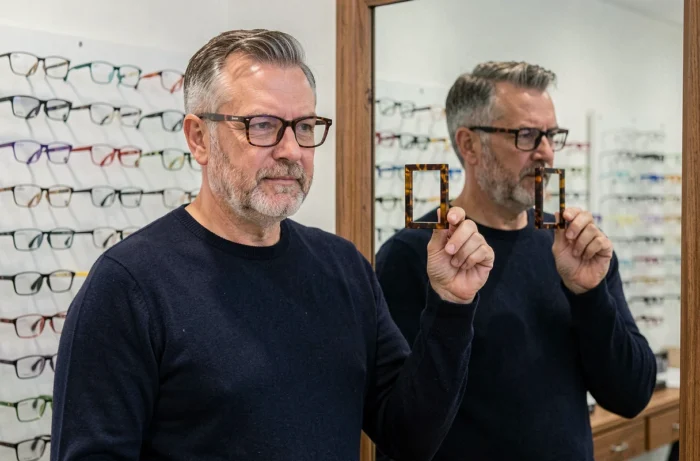
The material of the frame is not merely an aesthetic choice. It determines the weight on the bridge of the nose, durability, and overall visual rendering.
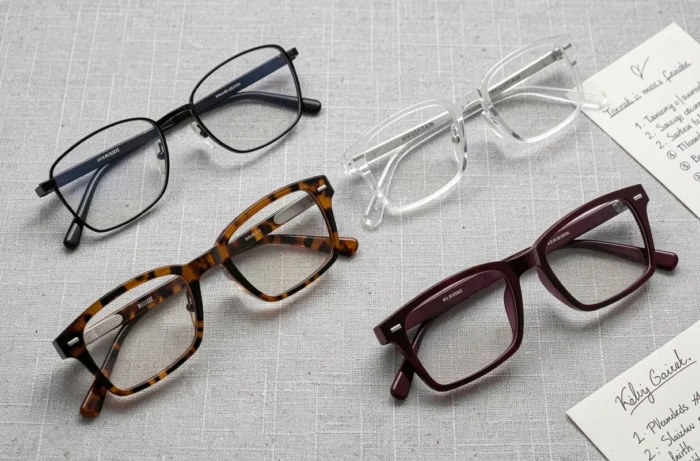
- Thin metal rectangular frames have become popular since 2024-2025 under the influence of the so-called “office siren” trend, which favors structured yet discreet frames in professional settings. They are lightweight, perform well in video conferencing, and are forgotten after a few hours of wear.
- Thick acetate provides a more assertive frame for the gaze. It suits those who want the frame to actively contribute to their look, with denser colors (tortoise, matte black, translucent). However, the weight is higher, and the fit on the nose depends more on the quality of the nose pads or bridge.
- Combined frames (acetate front, metal temples) attempt to strike a balance. They offer the visual presence of acetate with the lightness of metal on the temples, but their junction point remains a mechanical weak point in some models.
The choice of material benefits from being physically tested. A frame worn for thirty seconds in-store does not inform about comfort after four hours in front of a screen.
Frame width and optical correction: two related constraints
The width of the rectangular frame affects both harmony with the face and the quality of the correction. A frame that is too narrow compared to the width of the face creates a visual imbalance, but it also reduces the usable surface of the lenses.
For wearers of progressive lenses, the height of the lens is a non-negotiable technical parameter. A progressive lens requires a minimum height to accommodate the three vision zones (far, intermediate, near). Very thin rectangular frames, popular for their discretion, can compromise reading comfort if the lens does not offer enough vertical height.
The position of the eyes in the lens also matters. The pupillary axis should be slightly above the optical center. An optician measures this distance (mounting height) during fitting. Without this measurement, even a well-chosen frame can result in poorly centered correction.
Frame color and eye color
The color of the frame interacts with the iris hue and skin tone. Warm tones (gold, havana tortoise) enhance brown or hazel eyes. Cool tones (silver, black, midnight blue) accentuate the contrast with light eyes. Translucent frames, very present in recent collections, act as a neutral ground that does not compete with any skin or iris color.
Rectangular glasses in video conferencing: a criterion of choice that has become concrete
Remote work and video meetings have changed how a frame is perceived. On a screen, the webcam flattens the volumes of the face and accentuates reflections on the lenses. Thin metal rectangular frames perform better on screen than thick, dark models, which can create a visual bar across the top of the face.
Field feedback varies on this point depending on the quality of the camera and ambient lighting, but one constant emerges: a quality anti-reflective treatment avoids white halos that obscure the gaze in video. This treatment is independent of the frame shape but becomes particularly noticeable on rectangular frames with wide lenses, where the reflective surface is larger.
For mixed office-video use, prioritizing a frame color that does not blend with skin tone on screen helps maintain the structure of the gaze that the rectangular shape is supposed to provide.
Try before deciding: what online photos do not show
Virtual try-on tools have multiplied. They give a first idea of the shape on the face, but they do not convey weight, pressure from the temples, or the stability of the frame when looking down. The final adjustment by an optician (pantoscopic tilt, temple spacing, height of the pads) transforms a correct frame into a comfortable one.
Rectangular glasses, due to their rigid geometry, are less forgiving of fitting flaws than rounded shapes. A shift of a few degrees in tilt alters the useful vision area and the position of the gaze in the lens. Taking the time for a physical try-on remains the most reliable filter, even when the model has been spotted online.