
Comparing alarm monitoring services in Luxembourg means assessing what each solution actually guarantees, not just the features listed on a product sheet. Two criteria distinguish a reliable installation from a basic alarm kit: the response chain when an incident is detected, and the system’s resilience when the power, Internet or mobile network goes down.
Alarm receiving centre licence in Luxembourg: five authorised operators
A company that sells and installs equipment is not necessarily the one that receives and handles alerts. In Luxembourg, receiving alarm signals requires a specific ministerial licence. The list published on 29 January 2026 names five licence holders: Brink’s, Dussmann, Eltrona, G4S and Securitas.
Any other provider therefore outsources alarm monitoring to one of these centres. Before signing, it is worth asking for the exact name of the operator monitoring the alarm panel and checking that it appears on this list. A competent local installer may offer good equipment, but the reliability of the response depends on the alarm receiving centre at the end of the chain.
To explore the options available on the Luxembourg market, one useful resource is https://betavi.lu.
| Criterion | Licensed alarm receiving centre | Alarm without monitoring |
|---|---|---|
| 24/7 alert reception | Yes, by a trained operator | No (smartphone notification only) |
| Incident verification | Audio or video verification | Owner’s responsibility |
| Notification to the police | Possible after risk assessment | Owner must call themselves |
| Mobile patrol response | Depending on the contract (stated response time varies) | None |
| System fault monitoring | Signal loss detection | No automatic alert |
Power outage and loss of connection: what remains active in the system
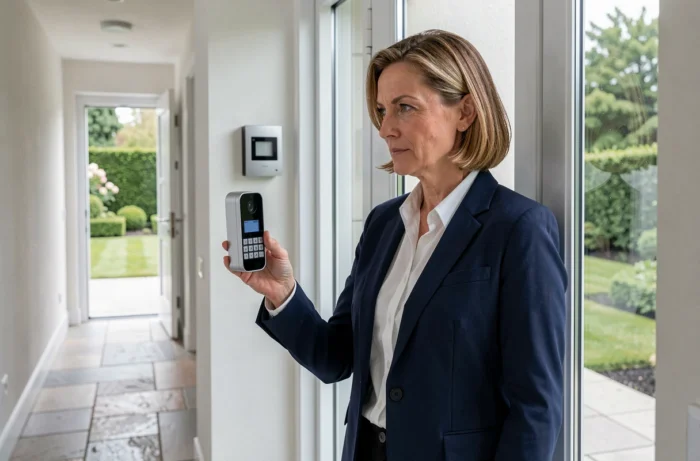
Competitors detail the sensors, cameras and mobile apps. They rarely explain what happens when everything goes dark. Yet this is the scenario that separates a reliable installation from a gadget.
Power outage
A quality alarm panel includes a backup battery. Brink’s, for example, says its Safety Home panel stays active using an internal battery during a power outage. Battery life varies by model and manufacturer. Ask the provider: how many hours the panel and detectors will run on battery power, and whether the battery is replaced during routine maintenance.
Loss of Internet
Most modern alarm panels in Luxembourg use a 4G connection as a backup to (or replacement for) the Internet router. An alarm panel with dual communication channels switches to the mobile network if the landline connection goes down. Without this redundancy, the panel goes silent as soon as the Wi-Fi or fibre connection fails.
Loss of mobile network
This is rare, but it can happen (antenna failure, deliberate jamming). A licensed alarm receiving centre detects the loss of the panel’s signal and can initiate a verification procedure. A system without monitoring, on the other hand, alerts no one: the owner may not even know their alarm has gone silent.
- Check that the panel has at least two transmission channels (fixed IP + 4G, for example)
- Ask whether the alarm receiving centre is automatically notified if the signal is lost, and how quickly
- Confirm the backup battery life and how often it is replaced
- Make sure the local siren sounds even when there is no active connection
Private alerts and police response: two separate channels
Connecting an alarm to a monitoring centre does not mean a police patrol will automatically arrive. POST Luxembourg’s Alarmis service can forward an alarm to the police’s national intervention centre, but only after the police themselves have assessed the risk.
In practice, the alarm receiving centre gets the signal, verifies the alarm (by calling the home, listening to audio or checking video), then contacts the police if it considers the intrusion confirmed. Without this step, false alarms would overwhelm police services.
Some providers also offer a private mobile patrol. The stated response time varies depending on the contract and geographical area. It is worth comparing this response time across offers, as it can differ significantly from one provider to another.
Video surveillance and CNPD rules: strict limits on camera coverage
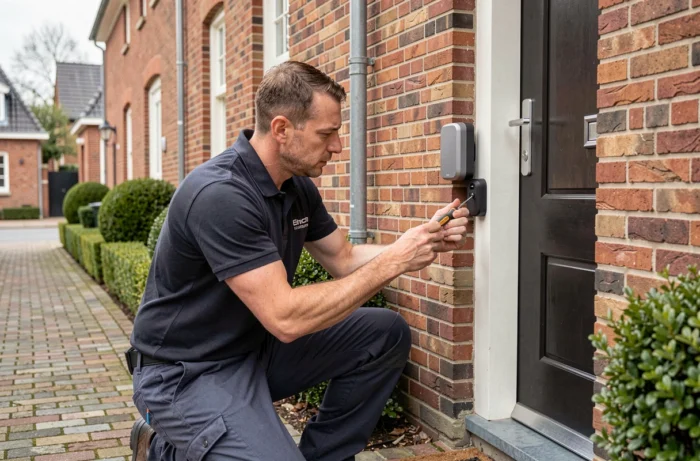
Installing cameras at home in Luxembourg is not a problem as long as they film only private property. The CNPD (National Commission for Data Protection) points out that filming the street, pavement or a neighbour’s property may fall outside the scope of the domestic-use exemption.
In a terraced house or a condominium, each camera’s field of view should be carefully adjusted during installation. Ask the technician to mask areas outside your property directly in the camera settings. A poorly configured system could expose the owner to a complaint to the CNPD, turning a security tool into a source of dispute.
Cybersecurity for connected alarms: remote access and updates
An alarm system connected to the Internet creates a digital entry point. Smart homes are among the potential targets of cyberattacks. Two precautions can significantly reduce this risk.
Where possible, choose a local architecture in which data travels over the internal network before reaching the cloud. Keep software up to date, and ask the provider how updates are delivered to the alarm panel and cameras. A system whose firmware is never updated accumulates known vulnerabilities.
A practical question to ask is: who manages the updates (the owner, installer or manufacturer remotely), and how often? If no one can give a clear answer, the risk increases over time.
Choosing an alarm monitoring solution in Luxembourg depends less on the number of sensors in the kit than on three verifiable factors: the alarm receiving centre’s licence, the system’s resilience to outages, and the response chain from alert to intervention. Check these three points before signing, not after the first incident.